


As Brent crude prices rise, the Indian rupee opens 20 paise lower at Rs 94.74.
- Blog Industry New Startup Trending News
- Entrepreneurs Story
- April 29, 2026
- 596
- 11 minutes read
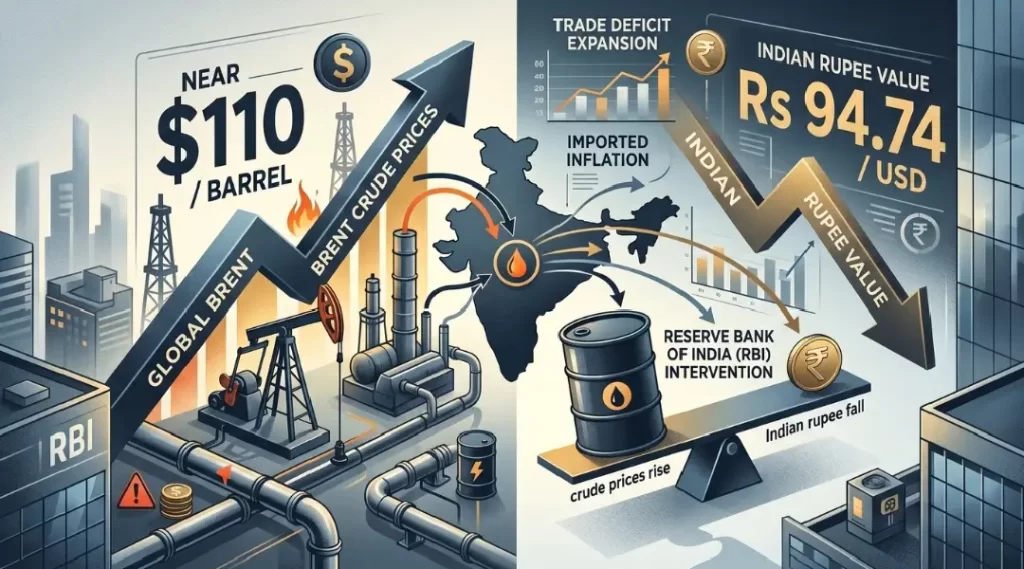
The Indian financial ecosystem is currently navigating a period of heightened sensitivity as global energy benchmarks exert significant pressure on domestic currency valuations. In recent trading sessions, the Indian rupee opened approximately 20 paise lower, reaching a level of Rs 94.74 against the US dollar. This depreciation is intrinsically linked to the trajectory of Brent crude prices, which have surged toward the $110 per barrel threshold. As a net importer of energy, India finds its fiscal stability and currency strength at the mercy of international oil markets, where a crude prices rise often dictates a subsequent Indian rupee fall.
The Interplay Between Brent Crude Prices and the Indian Rupee
The correlation between oil prices, GST collections, and the valuation of the Indian rupee is one of the most critical metrics for the Indian economy. India imports more than 80% of its total crude oil requirements, making the national budget highly susceptible to fluctuations in the global energy market. When Brent crude prices ascend, the demand for US dollars—the primary currency for international oil transactions—increases significantly within the domestic market. At the same time, higher fuel prices can influence GST collections indirectly through increased transportation costs and changes in consumer spending patterns.
This surge in dollar demand creates an imbalance in the foreign exchange market, leading to a natural Indian rupee fall. The recent opening at Rs 94.74 reflects the market’s immediate reaction to supply-side concerns and geopolitical tensions that have pushed Brent crude closer to the triple-digit mark. Financial analysts note that every dollar increase in the price of crude oil can potentially expand India’s trade deficit, impact inflation-linked GST revenues, and put a downward strain on the rupee’s exchange rate.
Market Dynamics and Exchange Rate Volatility
In early trade, the Indian rupee displayed notable volatility, slipping from its previous close as investors weighed the impact of sustained high energy costs. This Indian rupee fall is not happening in isolation; it is part of a broader trend where the US dollar remains resilient against a basket of major global currencies. Higher Brent crude prices act as a catalyst for inflation, which in turn prompts central banks to maintain a hawkish stance on interest rates.
Historically, the Indian rupee has faced similar headwinds. Recent market reports indicated a 24 paise fall to levels around 94.39, only to see the currency further weaken to the current 94.74 mark as crude prices rise persisted. This trajectory highlights the challenges faced by the Reserve Bank of India (RBI) in managing currency stability while ensuring that foreign exchange reserves are utilized strategically to curb excessive volatility.
Fiscal Implications of Rising Crude Prices
The economic consequences of a weakening Indian rupee coupled with a crude prices rise are multifaceted:
- Trade Deficit Expansion: As the cost of oil imports increases in dollar terms, the gap between India’s exports and imports widens, leading to a higher Current Account Deficit (CAD).
- Imported Inflation: A weaker Indian rupee makes all imports more expensive, which contributes to domestic inflationary pressures, affecting everything from logistics costs to consumer goods.
- Capital Outflows: Foreign Portfolio Investors (FPIs) often grow cautious when the Indian rupee fall becomes a trend, as it diminishes their returns in dollar terms, potentially leading to sell-offs in the Indian equity markets.
- Fiscal Pressure on Oil Marketing Companies (OMCs): Rising international costs force domestic oil companies to either absorb the loss or pass the burden to the consumer, both of which have significant political and economic ramifications.
The Strategic Role of the Reserve Bank of India (RBI)
To combat the Indian rupee fall, the RBI frequently intervenes in the spot and forward foreign exchange markets. By selling US dollars from its substantial reserves, the central bank can provide the necessary liquidity to prevent a free-fall of the Indian rupee. However, these interventions are often balanced against the need to maintain an adequate “war chest” for long-term economic stability.
While the current rate of Rs 94.74 is a cause for concern, market experts believe the RBI’s proactive management prevents the currency from breaching even more psychological support levels. The central bank’s primary objective remains the minimization of “jerky” movements in the exchange rate, rather than targeting a specific numerical value for the rupee.
Navigating Global Headwinds
The current economic climate underscores the vulnerability of the Indian rupee to external shocks. As long as Brent crude prices remain elevated due to production cuts or geopolitical unrest, the pressure on the domestic currency will likely persist. For businesses and investors, understanding the nexus between energy costs and currency valuation is paramount for strategic planning in 2026.
Frequently Asked Questions (FAQs)
Q1: Why does the Indian rupee fall when Brent crude prices rise?
India is a major oil importer. When crude prices rise, the country must pay more US dollars to secure its energy needs. This increased demand for dollars weakens the Indian rupee relative to the USD.
Q2: What is the current exchange rate for the Indian rupee against the US dollar?
A crude prices rise often leads to higher petrol and diesel costs. Furthermore, because a weak Indian rupee makes imports costlier, the price of various consumer goods and services may increase, leading to overall inflation.
Q3: How do rising Brent crude prices affect the common man in India?
A crude prices rise often leads to higher petrol and diesel costs. Furthermore, because a weak Indian rupee makes imports costlier, the price of various consumer goods and services may increase, leading to overall inflation.
Q4: Is a 20-paise drop in the Indian rupee significant?
In the world of currency trading, a 20-paise move is quite significant for a single session. It reflects immediate market anxiety regarding trade balances and international energy costs.