


Banker Turned Farmer Ajay Gopinath: Earning ₹75 Lakh from Microgreens!
- Blog Funding Industry New Trending News
- Entrepreneurs Story
- May 15, 2026
- 624
- 13 minutes read
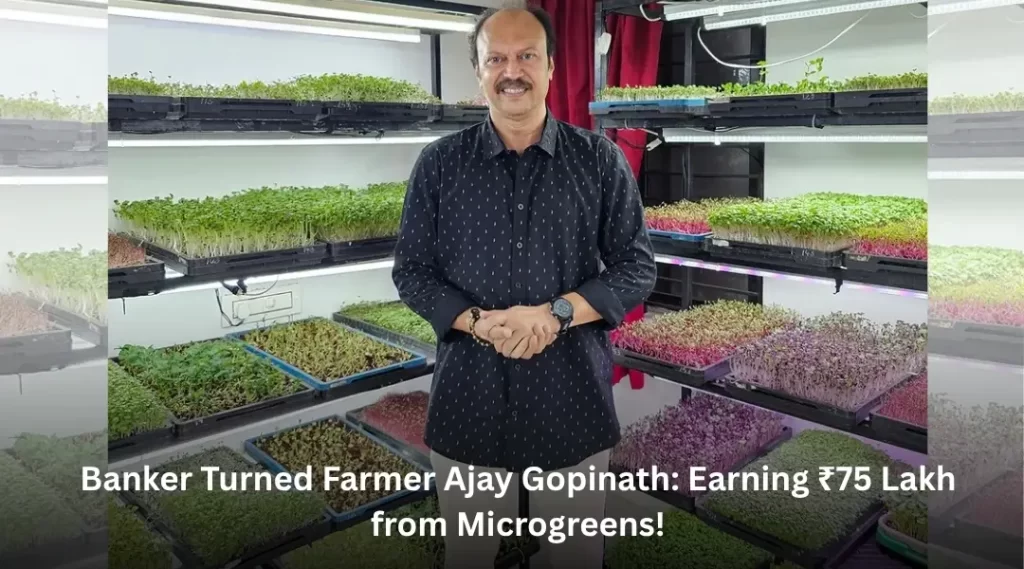
The modern professional can often find the move from high-stress corporate corridors to the agricultural field as a search for work-life balance. But for Ajay Gopinath, a former Citigroup banker from Kochi, Kerala, the move was not just a lifestyle choice, but a smart, high-margin business pivot. Gopinath saw a huge gap in the urban wellness market and successfully built Grow Greens Store – a strong indoor microgreens farming venture that crossed an annual revenue of ₹75 lakh in FY 2025–26.
His shift from managing credit cards and personal loans in the Bengaluru division of Citi Bank to growing nutrient-rich greens is a master class in contemporary entrepreneurship, proving that with the right technology, high-end organic seeds and a data-driven approach, agriculture has the potential to generate the same type of returns as traditional corporate investments.
The Strategic Shift :The Search for “Superfood” Arbitrage
Ajay Gopinath, who has almost 14 years of experience in the banking industry, started his entrepreneur story somewhat serendipitously in 2017, after spotting microgreens as garnish on his plate at a restaurant in Bengaluru. He was intrigued and after three years of research and experimentation, he launched Grow Greens Store in 2020.
Microgreens – seedlings just 7 to 14 days after germination – provided a high-turnover, space-efficient alternative to traditional vegetable farming, which requires vast tracts of land and long gestation periods. Gopinath worked in a small room measuring just 80 square feet that was kept at a temperature below 25 degrees Celsius and at humidity levels between 40 and 60 per cent. Today his venture is a benchmark for vertical indoor farming that proves high-density urban agriculture is a viable and highly profitable solution.
Scaling Science: Maintaining Quality Control and Organic Integrity
- Indoor Agriculture Accuracy
Gopinath, with his analytical background, learned to perfect the climate-controlled environment necessary for consistent yields. He plays with light spectrums, humidity and temperature to ensure his produce meets the high standards required by top-end restaurants and health-conscious consumers. His microgreens are four to 40 times more nutritious than a full-grown vegetable.
- Sustainable Input Procurement
One of the key differentiators has been the exclusive use of non-GMO, non-hybrid, non-treated, open-pollinated organic seeds – sourced from farmers in Srinagar, Uttarakhand, Bengaluru, Pune and Chhattisgarh – and also internationally from the UK, US, Australia, Italy and Israel. He uses low-EC cocopeat with pH balanced water for better hygiene and flavor profiles in accordance with the global “Clean Label” trend.
Market Penetration: Multiple Revenue Streams
To achieve a run rate of about ₹5 lakh a month, or ₹75 lakh annually, requires more than a good product. Gopinath’s revenue model is three-pronged:
- Product Sales: Offer more than 15 types of microgreens including radish, mustard, sunflower, beet and bok choy to gyms, hospitals, oncology departments, schools, luxury restaurants and five-star hotels.
- Subscription: Weekly farm-to-fork delivery for health-conscious urban consumers.
- Training & Installation Services: Ajay has helped over 30 farmers across India set up their own microgreen farms through paid training programmes and farm installation services contributing significantly to the revenue.
This diversity helps to spread risk, providing a steady cash flow and mitigating shelf-life and demand risks.
Socio-Economic Impact of Modern Agriculture
Ajay Gopinath is one of the growing number of agri-preneurs who are changing the face of the Indian farmer. He has applied corporate principles of efficiency, branding and logistics to agriculture to turn a niche interest into a high-performance business. His model also supports urban food security by growing food in the city, significantly reducing the carbon footprint of transporting food over long distances.
Conclusion: The Future of Urban Agri-Business
The banker-turned-farmer’s story is a case in point that the next big disruption in the Indian startup ecosystem could emerge from a climate-controlled grow room instead of a software lab. Ajay Gopinath has proven the agrarian sector is limitless for those willing to innovate with a focus on quality, dependence on organic seeds and an advanced understanding of market demand.
As Grow Greens Store plans to reach the ₹100 crore enterprise milestone in the next five years, his journey continues to serve as a blueprint for anyone who wishes to blend the precision of finance with the vibrancy of the natural world.
Frequently Asked Questions (FAQs)
1. Ajay Gopinath - Microgreens Business Story
Ajay Gopinath is a former banker with Citigroup from Kochi, Kerala who quit his job to take up farming. He discovered microgreens in 2017 at a Bengaluru restaurant and after three years of research started Grow Greens Store in 2020 from an 80 sq. ft. room at his home.
2. How much income does Ajay Gopinath earn from the microgreens business?
Grow Greens Store crossed ₹75 lakh in FY 2025–26 driven by sales of microgreens, training programmes and farm installation services — approximately ₹5 lakh a month.
3. Why are organic seeds important for microgreens farming?
Microgreens are consumed whole at a very young stage. Non-GMO, non-hybrid, non-treated and open-pollinated organic seeds ensure the product is free of harmful chemicals and adheres to the health requirements of premium buyers.
4. Is it possible to start a microgreens business with low investment?
Yes, this is exactly what Ajay Gopinath demonstrated. He started with only two trays. However, to achieve a ₹75 lakh revenue model, investment in climate control, high-quality seeds and a strong B2B and B2C marketing strategy is essential.
5. How long do Ajay Gopinath’s microgreens last?
Microgreens are highly perishable. Gopinath follows a just-in-time delivery model so that products often reach customers within hours after harvest, maintaining nutritional potency.
6. What types of microgreens does Grow Greens cultivate?
Grow Greens cultivates more than 15 different varieties of microgreens including radish (sango purple, china rose), mustard, sunflower, beet, bok choy, kohlrabi, corn and more.