


Alakh Pandey, the founder of Physics Wallah, joins the Billionaire Club and becomes worth $1 billion
- Blog Education Industry New Startup Trending News
- Entrepreneurs Story
- March 28, 2026
- 848
- 15 minutes read
Introduction
In the fast-paced world of Indian startups, where “burn rate” and “customer acquisition cost” are often the main topics of boardroom meetings, one man from Prayagraj has shown that profitability and purpose can go hand in hand. In March 2026, Alakh Pandey, the charming founder of Physics Wallah (PW), became an official member of the Billionaire Club. This was a big deal in the global EdTech scene.
Alakh Pandey’s rise from a small room in Uttar Pradesh to the Forbes World’s Billionaires List is not only a success story, but also a revolution. He is worth an estimated $1.75 billion (₹14,520 crore).
The Meaning: Alakh Pandey's First Billionaire
People will remember 2026 as the year that “mass-market” EdTech really took off. The successful IPO of Physics Wallah in late 2025 changed the course of the industry’s “funding winter” and global valuation corrections. After being listed at approximately 31% premium, Physics Wallah’s value shot up to an incredible ₹44,382 crore.
Because of how well the market did, Alakh Pandey became one of the few self-made billionaires. Pandey’s decision to keep almost 40% of the company’s equity meant that the company’s public success turned into a lot of personal wealth. This is different from many founders who see their stakes drop to single digits through multiple funding rounds.
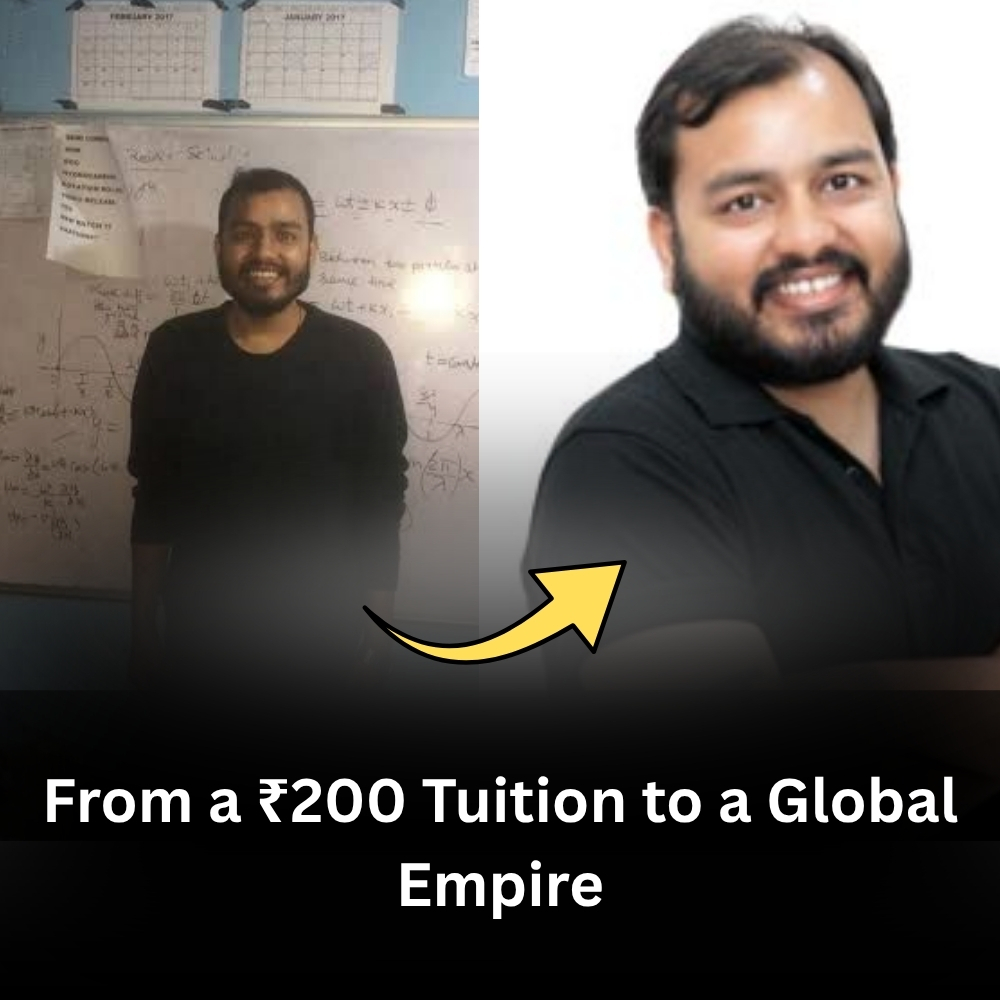
The Beginning: From a ₹200 Tuition to a Global Empire

To understand how much Physics Wallah is worth now, you need to know how it started out. Alakh Pandey was born in Prayagraj in 1991, and his early years were hard because he didn’t have much money. To stay alive, his family had to sell their house, which changed how he felt about the “value of money.”
The Brave Dropout
Alakh was finally accepted into the Harcourt Butler Technical University (HBTU) in Kanpur because he did so well in school. But he was too excited about teaching to follow the standard engineering curriculum. He bravely chose to leave school in his second year at HBTU Kanpur. He started teaching physics at a nearby coaching center for a very low pay after he got home.
In 2014, he made the Physics Wallah YouTube channel. For the first few years, he did everything by himself: set up the camera, taught on a whiteboard, and worked late into the night to edit videos. He was building a community while also teaching physics.
Building the Physics Wallah Valuation: The Trust-Based Business
Alakh Pandey focused on “Unit Economics” and “Student Sentiment” while his competitors spent billions on celebrity endorsements and aggressive marketing strategies.
1. Saying no to the ₹75 crore offer:
Early in his career, Pandey famously turned down a ₹75 crore offer from a competing EdTech giant. He showed his vision by saying no to such a life-changing amount of money when he had very little. He wanted to keep education affordable instead of becoming a “corporate employee.”
2. The Turning Point for 2020:
In 2020, Alakh and Prateek Maheshwari worked together to turn the YouTube channel into a fully functional EdTech platform. This is how the PW App came to be. While some companies charged ₹1 lakh for JEE coaching, PW only charged ₹4,000. The response was huge.
3. The Unicorn’s Jump:
Physics Wallah was worth $1.1 billion and raised $100 million. It became India’s 100th unicorn in 2022. What made this one stand out was that it was a “profitable unicorn,” which is very rare in the venture-backed industry.
| Metric | Details (2025-26) |
|---|---|
| IPO Issue Price | ₹109 |
| Listing Price | ₹143.10 |
| Market Cap | ~₹44,382 Crore |
| FY25 Revenue | ₹2,886 Crore |
| Subscriber Base | 14 Million+ |
Physics Wallah’s money is no longer just “paper wealth.” It has a huge network of more than 100 offline “Vidyapeeth” centers, hybrid learning models, and it is branching out into UPSC preparation, AI, and skill development.
Why "Alakh Pandey Billionaire" Status Matters for India
This is more than just one man getting rich. It is a warning to Indian startups:
- Content is King: Pandey showed that a business run by creators could do better than one run by marketers.
- The Power of Kanpur and Prayagraj: His successes show that Tier-2 India can make world-class businesses by hiring local talent and understanding what “real” India needs.
- Sustainable EdTech: PW’s focus on openness and results has set a new standard at a time when many EdTech companies are having trouble with money and the law.
The Future of Alakh Pandey
The focus has changed to expanding internationally, and Alakh Pandey’s net worth which is now trending everywhere with that of Bollywood stars like Shah Rukh Khan. Reports say that the company is looking into markets in Southeast Asia and the Middle East, where there is an unprecedented need for high-quality, affordable STEM education.
Also, Physics Wallah seems ready to lead the “EdTech 2.0” movement with the release of “Alakh AI,” a set of generative AI tools for personalized learning.
Frequently Asked Questions (FAQs)
1. Who is Alakh Pandey?
2. Why is Alakh Pandey in the news in 2026?
3. How did Physics Wallah start?
It began in 2014 as a YouTube channel where Alakh Pandey taught physics. Over time, it evolved into a full-scale EdTech platform with apps, courses, and offline centers
4. Why is Physics Wallah considered different from other EdTech companies?
Unlike competitors, it focused on affordability, student trust, and profitability instead of heavy marketing and high pricing.
5. What major decision did Alakh Pandey make early in his career?
He rejected a ₹75 crore offer from another EdTech company to keep education accessible and maintain control over his vision.
6. What are Physics Wallah’s future plans?
The company plans to expand internationally into Southeast Asia and the Middle East and is also developing AI-based learning tools like “Alakh AI.”
In conclusion, the teacher who became a titan
Alakh Pandey’s story of how he became a billionaire is a lesson in never giving up. He didn’t try to become a billionaire; instead, he built a billion-dollar company by trying to be the best teacher for a student in a remote village who had nothing but a ₹5,000 smartphone and a dream.
The legacy of Alakh Pandey will not be the money in his bank account, but the millions of Indian engineers and doctors who passed their exams because “Alakh Sir” made physics easy. The Physics Wallah valuation keeps going up.