

IndiGo Buys a Stake in Sarla Aviation and Enters the Flying Taxi Business
- Blog Funding Industry New Trending News
- Entrepreneurs Story
- April 16, 2026
- 583
- 14 minutes read
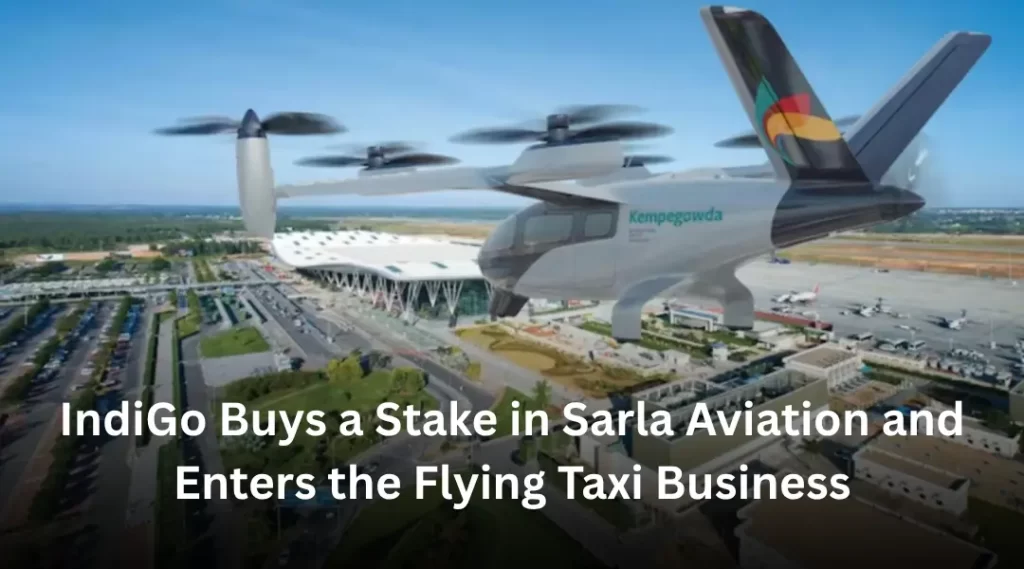
Go, India’s biggest airline, has officially bought a stake in the Bengaluru-based startup Sarla Aviation. This is a big step toward solving the country’s long-term problem of traffic jams in cities. This investment, made through the airline’s venture arm, IndiGo Ventures, shows that they have a lot of faith in Electric Vertical Takeoff and Landing (eVTOL) technology.
IndiGo is not only adding to its portfolio by supporting Sarla Aviation; it is also creating a new type of “Advanced Air Mobility” (AAM). The goal is clear: to turn the long, hard commutes of Bengaluru, Mumbai, and Delhi into smooth, 15-minute flights.
The Strategic Shift: Why Sarla Aviation?
IndiGo’s move into the eVTOL space comes after a big change in how it works with other companies around the world, while also aligning with the broader vision of Bharat taxi and next-generation urban mobility in India. Before, InterGlobe Enterprises, the airline’s parent company, had looked into a non-binding deal with Archer Aviation, which is based in the US. But since Archer couldn’t meet the strict delivery deadlines needed for the Indian market, IndiGo turned its attention to developing new ideas in-house.
Sarla Aviation was started by engineers who had worked for a long time at the German eVTOL company Lilium. They make a product that is specifically designed for Indian ground conditions. Their main plane, “Shunya,” is made to do well in crowded cities. It can use existing helipads at tech parks, hotels, and hospitals, so they don’t have to build a lot of new infrastructure, supporting the future ecosystem of Bharat taxi and advanced air mobility solutions in the country.
Technical Edge: Decoding the "Shunya" eVTOL
The technical skills of the Shunya aircraft are what make this partnership work. Sarla’s eVTOL is different from regular helicopters in that it is:
- Fully Electric: Flights with no emissions that fit with India’s goals for sustainability.
- Can hold six people: While a lot of other companies focus on 2- or 4-seater models, Sarla’s 6-passenger (plus pilot) setup is better for unit economics, which makes the service cheaper for the general public.
- Optimized Performance: Shunya is the best way to get around in cities like Bengaluru, where traffic is always bad. It can go up to 250 km/h and has a range that is best for 20–30 km urban hops.
- Strength of the Payload: It can handle a wide range of urban tasks, from corporate transportation to emergency medical services, because it can carry 680 kg.
From Concept to Giga-Factory: The Infrastructure Roadmap
IndiGo’s investment of ₹10 crore is part of a larger funding trend for Sarla Aviation. Other big names that have backed the company include Accel, the founders of Flipkart, Zerodha, and Swiggy. This money is helping to pay for an ambitious plan for infrastructure:
1. The Sky Factory in Andhra Pradesh
Sarla Aviation is building a “Sky Factory” on 500 acres in Anantapur, Andhra Pradesh. This integrated giga-campus, which is the first of its kind in India, will have manufacturing, flight testing, and certification units all in one place. The facility plans to make up to 1,000 aircraft per year by 2029, once it is up and running.
2. Vertical Corridors in the Region
The startup is already working with Bengaluru Airport and Cochin International Airport (CIAL) to build vertiport networks. These specialized hubs will be the starting points for India’s first air-taxi corridors, which will link busy areas like Kochi Airport to Munnar or Connaught Place to Gurugram.
Market Implications for the Indian Startup Ecosystem
We think this is a big deal for Indian DeepTech at entrepreneursstory.com. IndiGo’s decision shows that the “startup-to-corporate” bridge is getting stronger in the aerospace industry. This deal shows three important trends for business owners:
- Localization is King: Sarla got the IndiGo backing because she designed for Indian acoustics, temperatures, and cost concerns.
- Strategic Asset-Light Models: IndiGo gives the “customer rails” and operational brand, while Sarla gives the cutting-edge IP.
- The Growth of Urban Air Mobility (UAM): We are seeing the start of a multi-billion dollar secondary infrastructure market that includes battery technology, vertiport management, and AI-powered air traffic control.
IndiGo’s New Flight Path: Why the Sky is the Next Infrastructure
IndiGo and Sarla Aviation want to start flying commercial flights in Bengaluru in 2028. The “Vertical Sky” is the only logical place for growth now that ground-level infrastructure has reached its limits. IndiGo is positioning itself as a mobility titan by adding air taxis to its already extensive travel ecosystem, which includes airport cabs and international long-haul flights.
The dream of a “flight to the office” in 7 minutes is no longer just a fantasy; it’s about to become a reality as the Shunya begins its next phase of piloted flight testing in late 2027.
Frequently Asked Questions (FAQs)
Q1: What is the most recent news about IndiGo's air taxi service?
IndiGo Ventures has bought a ₹10 crore equity stake in the Bengaluru-based startup Sarla Aviation. By 2028, this partnership wants to start offering electric flying taxi services in India, starting with Bengaluru.
Q2: What is an eVTOL, and why is IndiGo using one?
Electric Vertical Take-off and Landing is what eVTOL stands for. It is a plane that uses electricity to hover, take off, and land straight up and down. IndiGo is supporting this technology because it is quieter, better for the environment, and cheaper for getting around in cities than regular helicopters.
Q3: How many people can the Sarla Aviation flying taxi fit?
The main plane, Shunya, can hold six passengers and one pilot. This higher seating capacity is a smart move to improve the unit economics and lower the cost of tickets for passengers.
Q4: What cities will be the first to get the IndiGo air taxi service?
The first launch is planned for Bengaluru, and then for other busy metros like Mumbai, Delhi-NCR, and Kochi. Sarla Aviation is already finding high-potential routes in Kerala, like the Kochi to Munnar route and other pilgrimage routes.
Q5: What is the Shunya flying taxi's top speed and distance?
The Shunya eVTOL can go as fast as 250 km/h. It works best for trips of 20 to 30 kilometers in the city, but with better batteries, it could go as far as 160 kilometers.
Q6: Why did IndiGo choose Sarla Aviation over global players like Archer?
IndiGo’s parent company looked into a partnership with Archer Aviation at first, but the deal was not binding and fell through because of delays in the timeline. Sarla Aviation provided a more localized, “Made in India” solution with a 6-seater design that works better with Indian infrastructure and economy.