


Best AI Tools of 2026: Free and Paid Applications Worth Your Time
- Blog Industry Technology Trending News
- Entrepreneurs Story News
- October 1, 2026
- 9
- 17 minutes read
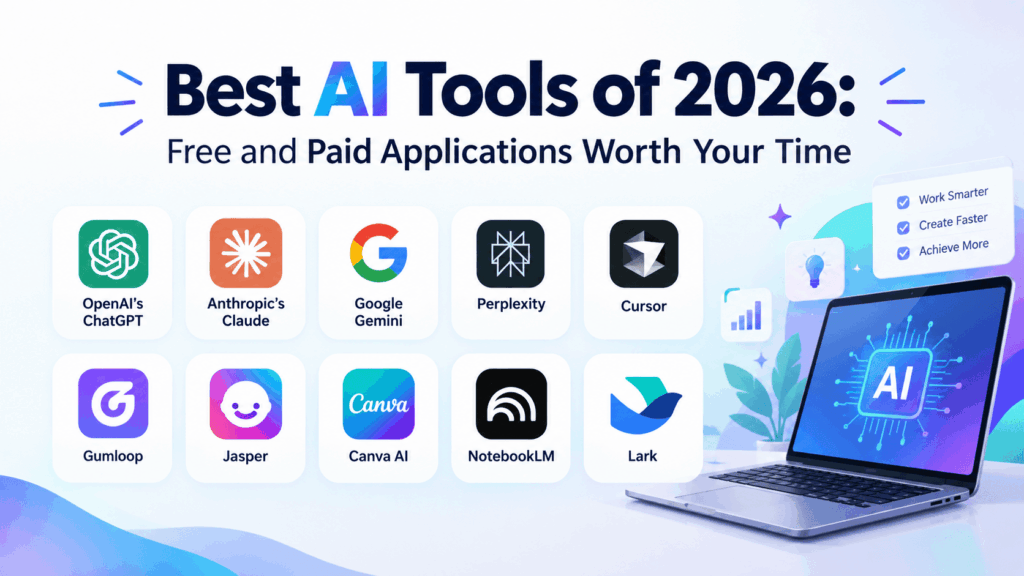
If you work in a modern office, you’ve probably noticed that AI stopped being a novelty somewhere in the last couple of years and turned into actual infrastructure. Teams now lean on this technology the way they once leaned on email or spreadsheets to draft, research, code, design, and organize.
The tricky part isn’t finding an AI tool anymore; it’s figuring out which one earns a place in your technology stack and which one is just noise. Choosing well means weighing what a platform actually does well against what it costs, which is why a clear-eyed comparison of free and paid AI software matters more than another hype-driven roundup.
Below is a rundown of the platforms professionals are actually relying on this year, including a few standout free AI tools with no limits worth trying before you spend a dime.
OpenAI's ChatGPT
ChatGPT is still the name most people reach for first, and it’s easy to see why. It handles everything from drafting a tricky client email to walking through a stubborn bug in your code, and it does both without much hand-holding.
- Range: a broad plugin ecosystem and natural conversation flow, even across long, meandering sessions.
- Flexible pricing: tiers run from a free entry point up to enterprise-grade plans, so it suits individual contributors and larger departments alike.
Anthropic's Claude
Claude has carved out a reputation for a different kind of strength: handling enormous amounts of text without losing the thread. Feed it a dense research paper, a sprawling contract, or months of internal documentation, and it stays coherent instead of drifting off-topic a problem that plagues plenty of competitors.
- Human-sounding writing: writers gravitate toward it because the output reads like something a person wrote, not something assembled from a template.
- Artifacts: lets teams build interactive prototypes right inside a conversation, making it a favorite for cross-functional groups.
For anyone assembling a shortlist of essential AI apps for productivity, Claude is hard to leave off.
Google Gemini
Gemini’s biggest advantage isn’t a single flashy feature it’s how deeply it’s woven into tools people already use every day. Docs, Sheets, Slides, Gmail: Gemini shows up inside all of them.
- Real-time data: pulls in live information and summarizes multi-format files without forcing anyone to switch apps.
- Ecosystem fit: organizations already living inside Google’s cloud get the most out of it, since routine cross-team collaboration becomes something closer to autopilot.
For solo users testing the waters before committing to a paid tier, it’s also one of the best free AI tools 2026 offers, with a surprisingly capable free version that scales cleanly into enterprise use.
Perplexity
Perplexity approaches the whole category differently it’s built around answering questions with receipts. Instead of a wall of blue links, it hands back a synthesized answer with the sources cited right there.
- Research-ready: genuinely useful for market research or competitive analysis where you need to know where a claim came from.
- Less clutter: analysts and marketers use it to cut through search-engine noise and get verified information fast.
That’s exactly why it keeps coming up whenever people list the top AI tools for digital marketers who need data they can actually defend in a meeting.
Cursor
Cursor has changed how a lot of engineering teams write code day to day. It’s not just auto-complete with a fresh coat of paint.
- Repo-wide awareness: it indexes an entire repository and understands how files relate to one another.
- Multi-file edits: suggests changes across several files at once instead of one line at a time.
- Everyday wins: move faster through feature work, catch syntax issues before they become bugs, and untangle legacy code without starting from scratch.
Among AI tools for content and code creation, it’s become something close to a default for technical teams that ship often.
Gumloop
Gumloop fills a gap that a lot of these other tools don’t touch: connecting different AI models and databases into one automated pipeline, without requiring anyone on the team to know how to code.
Its node-based canvas lets people drag together multi-step workflows scraping data, routing it somewhere else, triggering an action and just let it run. Operations-heavy teams lean on it to kill the manual busywork that used to eat up entire afternoons, which makes it a quiet but genuinely useful addition to any modern ops stack.
Jasper
Jasper is built for marketing departments that need volume without losing brand consistency. It’s less about a single clever output and more about repeatability.
- Consistent voice: the same tone across a hundred blog posts, ad variations, and social captions.
- Brand-tuned templates: output is pulled from templates shaped by a brand’s style guide.
For large content teams trying to keep pace with a publishing calendar, that consistency is the whole point, which is why it shows up so often on lists of the top AI tools for digital marketers.
Canva AI
Canva AI took design work that used to require actual training and handed it to anyone with an idea and a few minutes.
- Prompt to image: type a prompt and get custom imagery.
- One-click resizing: adapt a layout for five different social platforms at once.
- Quick cleanup: erase something distracting from a photo without opening a separate editing program.
It’s become a go-to for marketers and small business owners who need professional-looking graphics without a design department, and it fits comfortably alongside other AI tools for content and code creation on any modern team’s toolkit.

NotebookLM
NotebookLM takes a more disciplined approach than most AI assistants: it only answers from the documents you give it.
- Contained knowledge base: upload research papers, meeting notes, or internal reports.
- Useful outputs: generates summaries, study guides, and even audio overviews, all grounded strictly in your source material.
That grounding matters for teams that can’t afford a confidently wrong answer, and it’s a big reason people managing heavy research loads treat it as one of the essential AI apps for productivity they actually trust.
Lark
Lark bundles messaging, docs, scheduling, and an AI assistant into a single workspace, which sounds unremarkable until you’re the one juggling five different apps just to run a meeting.
- Real-time translation: translates conversations across languages as they happen.
- Fast summaries: condenses a meandering group chat or a two-hour meeting into something skimmable in under a minute.
Distributed teams spread across time zones use it to keep everyone on the same page without adding another tool to the pile, and it’s earned its spot among the tools people mean when they talk about the best AI productivity software for global teams.
The Bottom Line
Taken together, these platforms show how wide the artificial intelligence field has gotten. There’s no single winner among the best AI tools of 2026; the right pick depends on whether you’re writing, coding, designing, researching, or trying to keep a distributed team in sync.
Most professionals end up running two or three of these side by side rather than betting on just one.
Frequently Asked Questions (FAQ's)
1. What are the best AI tools of 2026 for boosting overall workplace efficiency?
ChatGPT, Claude, and Gemini are the three most commonly cited among the best AI tools of 2026 for everyday efficiency. They:
- automate routine tasks
- summarize meetings
- clean up multi-channel communication without much setup
2. Are there reliable options for free and paid AI software on the market?
Yes. Most major providers now offer a genuinely usable free and paid AI software structure a solid free tier plus a paid upgrade path so teams can scale spending as their needs grow instead of committing upfront.
3. Which options qualify as essential AI apps for productivity for remote teams?
Claude, Notion AI, and Zapier are frequently used by distributed teams to manage knowledge bases, automate repetitive workflows, and keep project documentation organized across time zones.
4. Where can professionals find the best free AI tools 2026 for individual use?
Gemini, ChatGPT, and Perplexity all offer capable free versions, which is why they’re regularly named among the best free AI tools 2026 for everyday writing, research, and light data analysis.
5. What are the top AI tools for digital marketers to scale campaigns?
Jasper, Perplexity, and Midjourney are common picks for marketers who need fast research, high-converting ad copy, and visual assets without waiting on a full creative team.