


GitLab Plans to Open Its First India Office in Bengaluru to Expand Its Software Development Business
- Blog Industry Startup Trending News
- Entrepreneurs Story News
- October 10, 2026
- 14
- 17 minutes read

India has one of the fastest-growing developer communities in the world, and GitLab wants a bigger share of it. On October 9, 2026, CEO Bill Staples told Moneycontrol that the DevSecOps company plans to open its first office in India, most likely in Bengaluru.
The exact location and opening date haven’t been officially confirmed yet. Even so, the plan marks a real shift for a company that has run as an all-remote business for most of its life, and that shrank its global footprint earlier this year.
Here’s what we know so far about the GitLab Bengaluru plan, what it means for developers and job seekers, and how it fits into the GitLab vs GitHub race in India.
What the Company Does and How It Makes Money
The company sells a single DevSecOps platform that covers the whole software lifecycle: planning, source code management, CI/CD, security testing and deployment. Instead of stitching together separate tools, teams work in one application, which cuts down a lot of integration work.
It follows an open-core, tiered subscription model. There’s a Free tier, plus paid Premium and Ultimate tiers, with Ultimate adding advanced security and compliance features. AI features sit under the Duo brand, and in fiscal 2026 the company introduced usage-based pricing for its Duo Agent Platform.
Customers range from small startups to large global enterprises. The company says more than 50 million registered users and over half of the Fortune 100 use its platform.
What We Know About the GitLab Bengaluru Office
Details are still thin. According to Staples, the aim is to “capture the growing demand” in India. No address, opening date, investment figure or hiring target has been announced.
Bengaluru is the obvious front-runner. It has India’s deepest pool of software talent, a dense cluster of enterprise tech teams and global capability centres, and well-known engineering colleges nearby.
GitLab Careers: What Roles to Expect
For job seekers, the GitLab Careers page is the one to watch. Recent India-linked listings include a Director of Support to build and scale a Bengaluru support hub, along with backend engineering, support engineering, database, solutions architecture, and recruiting roles.
Because the company is still remote-first, some of these roles may not require going into an office every day. Job listings also don’t confirm a final headcount, so treat early openings as signals rather than a fixed hiring plan.
If you’re aiming for GitLab Bengaluru office engineering jobs, highlight skills in Ruby on Rails, Go, Kubernetes, CI/CD and cloud infrastructure, since these sit at the core of how the product is built and run.
Why India, and Why Now
Two forces are driving the move. First, Indian enterprises are modernising how they build and ship software, and many want secure, automated pipelines they can audit. Second, the country’s developer base is huge and still growing.
GitHub’s Octoverse 2025 report found that India added more than 5.2 million developers that year, more than any other country, and projects over 57 million Indian developers by 2030.
GitLab vs GitHub in India
Any comparison between the two starts with scale. Microsoft-owned GitHub set up its Indian subsidiary in 2020 and has a much larger open-source community. Its rival’s pitch is different: one platform with built-in CI/CD and security, plus self-managed deployment options that appeal to banks, government bodies and other regulated sectors.
A local office won’t change that balance overnight. It should, however, help with enterprise sales, faster support and closer ties to India’s developer community.
Company History and Funding
The project began in October 2011, when Ukrainian developer Dmitriy Zaporozhets started building it with Valeriy Sizov. Dutch entrepreneur Sid Sijbrandij got involved in 2012, and the company was incorporated in 2014. It went through Y Combinator in early 2015 (company history).
Over the next decade, it grew from a code-hosting tool into a full DevSecOps platform. Sijbrandij led the company as CEO until December 2024, when he stepped back to focus on cancer treatment and became executive chair.
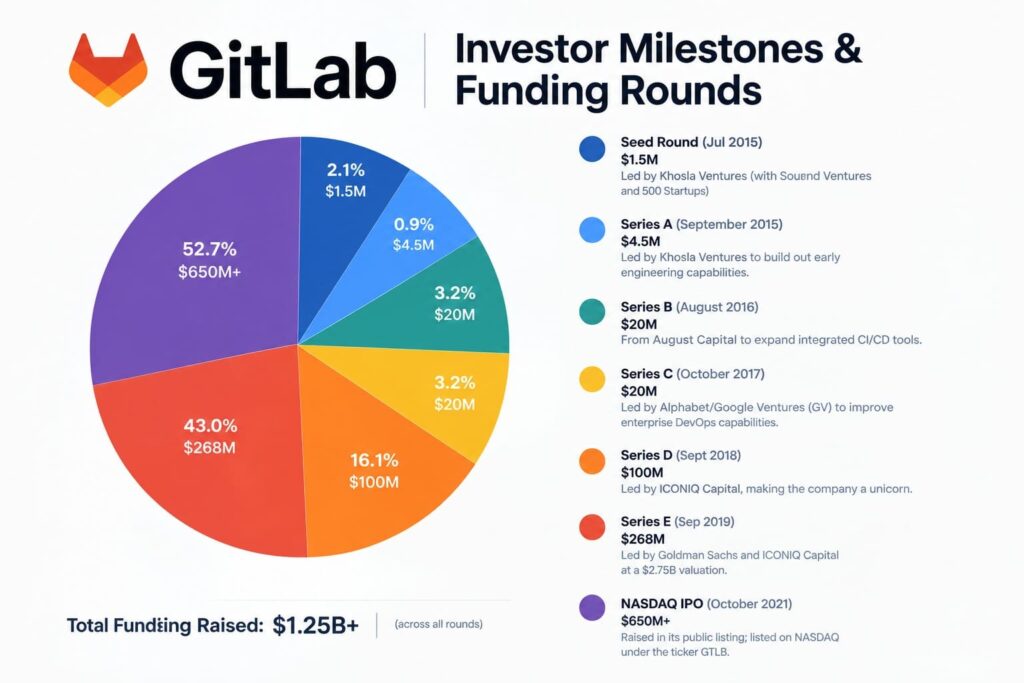
- Seed Round (Jul 2015): $1.5M led by Khosla Ventures with participation from Sound Ventures and 500 Startups.
- Series A (September 2015): $4.5M led by Khosla Ventures to build out early engineering capabilities.
- Series B (August 2016): $20M from August Capital to expand integrated CI/CD tools.
- Series C (October 2017): $20M led by Alphabet/Google Ventures (GV) to improve enterprise DevOps capabilities.
- Series D (Sept 2018): $100M led by ICONIQ Capital, making the company a unicorn.
- Series E (Sep 2019): $268M led by Goldman Sachs and ICONIQ Capital at a $2.75B valuation.
- NASDAQ IPO (October 2021): Raised $650M+ in its public listing; listed on NASDAQ under the ticker GTLB.
What It Means for Indian Enterprises
For Indian companies already on the platform, a local team should mean quicker support, smoother onboarding, and more hands-on technical help.
Artificial intelligence is the bigger opportunity. There’s no public data yet on GitLab Duo AI adoption in Indian enterprises, but interest in AI-assisted coding is high, and the company has been hiring for India-focused AI roles.
It recently advertised a Senior Director, Enterprise Technology & AI India position. Being on the ground makes those deals easier to win, especially in banking and other regulated industries where security and data control come first.
Company Overview
Parameter | Details |
Company name | GitLab Inc. |
Industry | Enterprise software / DevSecOps |
Origins | Open-source project started in 2011; company incorporated in 2014 |
Founders | Dmitriy Zaporozhets and Valeriy Sizov (project); Sid Sijbrandij (co-founder of the company) |
CEO | Bill Staples (since December 2024) |
Headquarters | All-remote, with no official headquarters (press releases are datelined San Francisco) |
Core product | Single DevSecOps platform |
Products | Source code management, CI/CD, security testing, Duo AI features |
Business model | Open-core, tiered subscription (Free, Premium, Ultimate) plus usage-based AI pricing |
Revenue | $955.2 million in fiscal 2026, up 26% |
Listing | Nasdaq: GTLB (since October 2021) |
India plans | First office planned, likely in Bengaluru (announced October 2026; not yet confirmed) |
Conclusion
A first India office, likely in Bengaluru, would be a big step for a company that built its reputation on being fully remote.
It would bring the business closer to one of the world’s largest developer communities and to enterprises that are spending heavily on secure, automated software delivery.
For developers, the advice is simple: keep an eye on GitLab Careers and on new GitLab Bengaluru office engineering jobs as they appear.
For enterprises, the story to follow is GitLab Duo AI adoption in Indian enterprises, and whether local support makes it easier to bring AI into regulated workflows.
Watch for an official announcement on the location and timeline as the Indian technology market keeps growing.
Frequently Asked Questions (FAQ's)
1. When was GitLab founded?
The open-source project started in 2011, and the company was incorporated in 2014. Dmitriy Zaporozhets and Valeriy Sizov began the project, and Sid Sijbrandij co-founded the business.
2. Is the GitLab Bengaluru office open yet?
No. As of October 2026, the office is only planned. Bengaluru is the likely location, but it hasn’t been officially confirmed.
3. What roles might the India office hire for?
Recent listings point to support leadership, backend and support engineering, database, solutions architecture and recruiting roles. The official careers page has the latest openings.
4. How does the company make money?
Through Free, Premium and Ultimate subscription tiers, plus usage-based pricing for its Duo AI agent features.
5. Where is the company's headquarters?
It has no official headquarters. The company is all-remote, although its press releases are datelined San Francisco.