


Best AI Agents for Business Automation in 2026: Platforms, Frameworks, and Use Cases
- Blog Industry Technology Trending News
- Entrepreneurs Story News
- October 26, 2026
- 22
- 18 minutes read
A few years ago, most companies used AI like a smart chatbot. You asked a question, and it gave you an answer. Today, things are different. The best AI agents for business automation can take a goal, split it into small steps, use tools like your CRM or ERP, and check their own work. A person only steps in when a real decision is needed.
But agents are not running whole companies yet. Gartner expects that more than 40% of agentic AI projects will be cancelled by the end of 2027. The main reasons are high costs, unclear business value and weak risk controls. That’s why picking the right tool, and the right first task, matters so much.
In this guide, you’ll see the top platforms, learn when a no-code AI agent builder for business is the better choice, and find out where agents are already saving time.
What Is an Enterprise AI Agent?
An enterprise AI agent is software that works towards a business goal on its own. It is usually powered by artificial intelligence, most often a large language model (LLM). Older robotic process automation (RPA) follows fixed rules and can stop working when a screen or file format changes. AI agent software for business process automation is more flexible. It can handle messy information and decide what to do next.
Most agents work in four steps:
- Read: They take in emails, tickets, contracts and data.
- Plan: They break a big goal into small steps. This planning is not 100% predictable, so safety checks are important.
- Act: They use other software, databases or apps to get the job done.
- Remember and review: They keep track of what has happened and fix their next step based on the results.
The goal isn’t to replace people. It’s to free them from boring, repetitive work so they can focus on checking, approving and improving it.
Enterprise AI Agent Platforms Comparison 2026
There is no single “best” platform for everyone. The right one depends on where your data is, how strict your industry rules are and how many developers you have. Here are the main options.
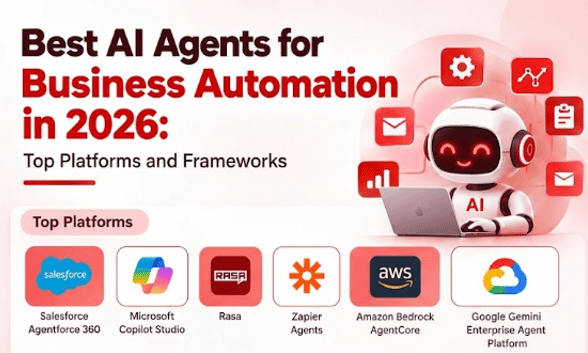
1. Salesforce Agentforce 360
Agentforce 360 is Salesforce’s AI agent platform. It runs on the Atlas Reasoning Engine and uses your customer data from Data 360 (earlier called Data Cloud).
- Advantages: Works directly inside Salesforce, uses your existing CRM data, and needs little extra setup.
- Best use: Sales and customer service teams that already use Salesforce.
2. Microsoft Copilot Studio
Copilot Studio lets you build AI agents with a low-code, drag-and-drop tool. It runs on Microsoft’s cloud (Power Platform) and connects easily with Microsoft 365.
- Advantages: Easy to start with, works smoothly with Teams, Outlook and SharePoint, and uses your existing Microsoft logins.
- Best use: Companies that already work on Microsoft 365.
3. Rasa
Rasa is a platform for chat and voice agents that you can host on your own servers, in a private cloud or even fully offline. Its CALM system mixes AI understanding with fixed business rules. (Rasa says its orchestrator is patented.)
- Advantages: Full control over your data, strong rule-following and support for voice.
- Best use: Banks, healthcare and other strictly regulated businesses.
4. Zapier Agents
Zapier Agents lets you create AI agents that work across your apps without writing code. It connects to more than 8,000 apps.
- Advantages: No coding needed, a huge number of app connections and a quick setup.
- Best use: Small and mid-sized businesses that want to automate work across many tools.
5. Amazon Bedrock AgentCore
AgentCore is Amazon Web Services’ (AWS) service for running AI agents. It became generally available in October 2025 and gives you ready-made pieces like runtime, memory, identity and monitoring.
- Advantages: Works with almost any agent framework, scales on AWS, and has built-in security and monitoring.
- Best use: Companies whose systems already run on AWS.
6. Google Gemini Enterprise Agent Platform
The Gemini Enterprise Agent Platform is Google Cloud’s platform for building and managing AI agents. It includes Agent Studio and ADK 2.0, Google’s code-first toolkit for multi-agent systems.
- Advantages: Strong Gemini models, both no-code and code options, and tight links with Google Cloud.
- Best use: Companies that use Google Cloud or Google Workspace.
Use this enterprise AI agent platforms comparison 2026 as a starting point, not a final ranking. Always test a small pilot on your own data before you decide.
No-Code Builders vs Code-First Frameworks
Companies usually choose one of two paths to adopt this technology: a ready-made builder that anyone can set up, or a framework that developers build on.
No-Code and Low-Code Builders
These tools let non-technical staff create agents using simple screens and settings. Examples include Zapier Agents, Relevance AI and Microsoft Copilot Studio.
- Advantages: Fast to launch, no developers needed and easy to change later.
- Best use: Business teams that want quick results with common apps.
Code-First Frameworks
These are coding toolkits for developers. Examples include LangGraph, CrewAI, the OpenAI Agents SDK, Microsoft Agent Framework and Google ADK.
- Advantages: Full control, custom features and the option to keep everything on your own servers.
- Best use: Companies with strict security rules or very specific needs.
When a No-Code AI Agent Builder for Business Makes Sense
If you don’t have AI engineers, a no-code builder is the quickest way to start. With tools like Zapier Agents and Relevance AI, a sales or operations manager can set up an agent just by choosing a trigger, writing simple instructions and connecting apps. Relevance AI says non-technical teams can build their own “AI workforce” in hours.
One tip: before you connect any tool to customer data, check that it offers user permissions, activity logs and approval steps.
Best Open-Source AI Agent Frameworks 2026
If ready-made tools can’t meet your security or compliance needs, these are the top AI agent frameworks for enterprise teams to try:
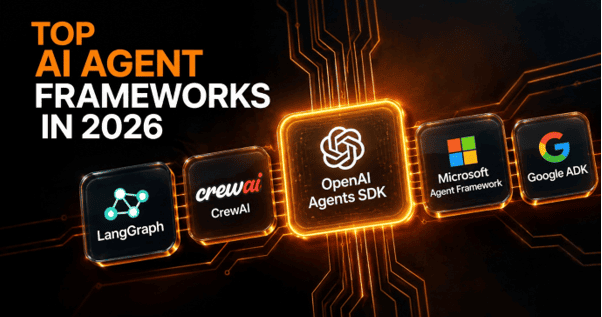
- LangGraph: Built for long-running agents. It can save progress, pause for human approval, and remember past steps.
- CrewAI: A free, open-source (MIT) framework where you build a “crew” of agents, each with its own role. Its paid CrewAI AMP version adds hosting and governance tools.
- OpenAI Agents SDK: A simple toolkit with agents, handoffs, safety checks and tracking. It also works with models from other companies.
- Microsoft Agent Framework: Microsoft’s newer framework that builds on Semantic Kernel and AutoGen. Version 1.0 came out in April 2026.
- Google ADK: Google’s toolkit for building multi-agent systems, now on version 2.0.
Where AI Agents Are Saving Time Today
Autonomous artificial intelligence agents for workflow automation work best on tasks that happen often, follow clear rules but come with messy information. Here are three common examples.
1. Finance and Invoices
Old scanning tools struggle when every invoice looks different. An agent can read each invoice, match it with the purchase order, spot mistakes and send it for payment approval.
2. Customer Service and Voice
Call centres use agents to answer common questions over chat and phone. In banking and healthcare, agents can check a customer’s identity, share claim status or answer billing questions, and pass difficult or sensitive cases to a human. Every step is recorded.
3. Supply Chain and Stock
Agents can keep an eye on stock levels, read supplier delivery updates, take alerts like weather warnings into account and prepare reorder requests for a manager to approve.
Choosing the Best AI Agents for Business Automation 2026: A Simple Checklist
Even the best AI agents for business automation can fail without a clear plan. Keep these five tips in mind:
- Start with one task. Pick one clear process first. Once it works well, add more agents.
- Add safety checks. Set rules, permissions and spending limits for important work. Agents without limits can create legal and money risks.
- Keep a human involved. For big payments or public messages, let the agent prepare a draft and wait for approval.
- Measure results early. Track time saved, mistakes and cost per task. Gartner says unclear business value is one of the top reasons agent projects get cancelled.
- Decide: build or buy. Paid platforms get you started faster. The best open-source AI agent frameworks 2026 has to offer give you more control and help you avoid lock-in, but your team has to maintain them.
Conclusion
AI agent technology is now ready for real work, but success depends on choosing the right tool. The best AI agents for business automation are the ones that fit the systems you already use.
Salesforce users will like Agentforce, Microsoft users will prefer Copilot Studio, and strictly regulated businesses may choose a self-hosted option like Rasa.
Teams with developers can build exactly what they need on open-source frameworks. Start small, keep people in the loop, and grow what works.
Frequently Asked Questions (FAQ’s)
1. Best AI agents for business automation 2026: which should you choose?
It depends on the tools you already use. Agentforce suits Salesforce users, Copilot Studio suits Microsoft 365 users, Rasa suits strictly regulated industries, and Zapier Agents suits small businesses.
2. What are the top AI agent frameworks for enterprise development?
LangGraph, CrewAI, the OpenAI Agents SDK, Microsoft Agent Framework and Google ADK.
3. Should my company use a no-code AI agent builder for business or custom code?
Use no-code if you want quick results without developers. Use custom code if you have strict security or data rules.
4. How do multi-agent orchestration platforms help businesses?
They split a big job between several agents, which makes the work easier to check. They cost more to run, so they’re best for complex tasks.
5. What is AI agent software for business process automation used for?
Invoices, customer service, IT tickets, sales follow-ups and stock reordering.