


Gurgaon E-Grocery Startup Satvacart Shuts Down After a 12-Year Run
- Blog Industry New Startup Trending News
- Entrepreneurs Story News
- August 31, 2026
- 794
- 17 minutes read
After twelve years of quietly delivering groceries around Gurgaon, Satvacart shuts down for good. The company ran its last day of operations on August 28, 2026, and founder Rahul H. Saxena confirmed the closure in a LinkedIn post to employees, investors, and customers bringing down the curtain on one of the earliest players in India’s online grocery business.
The news lands as one more entry in a long list of Indian startup closures from the e-grocery space, but Satvacart’s story is a little different from most. It wasn’t a company that burned through hundreds of millions of dollars and collapsed. It survived on comparatively little money, stayed profitable in patches, and still couldn’t outlast a market that changed shape twice under its feet.
How a 2014 dairy-delivery idea became a 12-year business
Satvacart started in Gurugram in 2014, back when organized online grocery delivery barely existed in India. It began small a subscription dairy service before growing into a full inventory-led delivery operation covering fruits, vegetables, and household staples across the city.
Rather than chase scale across multiple cities, Satvacart built its own warehouses and micro-fulfilment hubs and stuck to Gurgaon. In 2015, it raised a seed round backed by Palaash Ventures along with a group of angel investors, and used that money to build out its supply chain rather than spend heavily on marketing. The approach paid off, in a modest way: by 2019, the company said it had reached profitability in some of its clusters a milestone very few grocery-delivery startups in India could claim at the time.
Timeline at a glance
Year | Milestone |
2014 | Founded in Gurugram as an early mover in online grocery |
2015 | Seed round closed, led by Palaash Ventures with angel participation |
2018 | Final recorded funding round an angel cheque of roughly $221,000 (Jan 9) |
2019 | Reached early profitability in select delivery clusters |
Aug 28, 2026 | Ceased operations; founder announces closure on LinkedIn |
Why it finally ran out of road
A few overlapping pressures pushed the company toward closure.
The money never matched the moment.
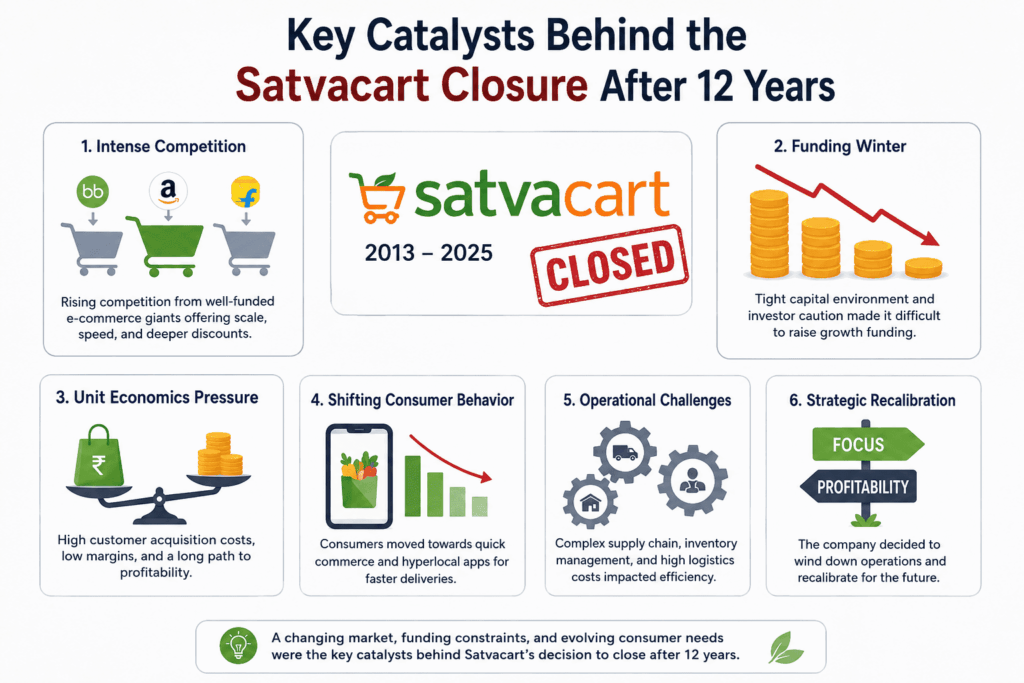
Over its lifetime, Satvacart raised about $2.32 million across four rounds and its last funding event was a roughly $221,000 angel round in January 2018. That means the company kept operating for another eight and a half years without a fresh infusion of institutional capital. Compare that to Zepto, a quick-commerce rival founded seven years later, in 2021, which has raised close to $2.34 billion. Small, steady funding is workable when a market is standing still; it becomes a serious handicap once competitors start raising capital a thousand times faster.
Quick commerce rewrote the rules of grocery delivery.
India’s grocery delivery habits shifted hard toward 10-minute fulfilment over the past few years. Blinkit, Zepto, and Swiggy Instamart poured money into dense dark-store networks, while Flipkart Minutes and Amazon Now brought horizontal e-commerce muscle into the same race. Interestingly, Satvacart itself had tried to move in this direction too its app promised 10-minute delivery slots in its final years but doing that on a few million dollars, against rivals spending billions on dark stores, was never a fair fight.
Being profitable wasn’t enough to attract a buyer.
As the market consolidated, Satvacart looked for a way out through funding or acquisition. According to the founder, the company held discussions with larger investors and explored acquisition conversations with multiple players but none of it converted. Acquirers in this category are typically shopping for dark-store density and order volume they can fold into an existing network, not a lean, disciplined operation with a modest customer base. The same restraint that kept Satvacart alive for over a decade was also what made it too small to be worth buying.
“There came a point where continuing operations was coming at the cost of the people who had stood by the company,” Saxena wrote in his closure announcement.
Satvacart vs. quick commerce, by the numbers
Metric | Satvacart | Zepto (for scale) |
Founded | 2014 | 2021 |
Total funding raised | ≈ $2.32 million | ≈ $2.34 billion |
Core delivery model | Scheduled delivery, later added 10-min slots | 10-minute delivery from launch |
Operating city | Gurgaon only | Multi-city, national |
Status (Aug 2026) | Shut down | Active, IPO-track |
What it says about India's e-grocery market
Satvacart’s exit is a useful data point for anyone tracking the hyperlocal grocery delivery India has built over the past decade. It shows that the old rules of startup survival keep costs lean, protect your margins, grow only where it’s profitable don’t automatically apply once a category turns into a capital arms race. The comparison below lays out how the ground shifted under companies like Satvacart.
Factor | Legacy e-grocery model | Modern quick-commerce model |
Delivery speed | Scheduled, multi-hour or next-day slots | Sub-15-minute, on-demand |
Infrastructure | Centralized or regional warehouses | Dense network of micro dark stores |
Capital intensity | Lean, moderate operating spend | Heavy, continuous cash burn |
What investors reward | Unit margins and retention | Market share and network density |
A Gurgaon e-grocery startup surviving 12 years on roughly $2.3 million, while a competitor a fraction of its age raises a thousand times more, is not really a story about one company’s mistakes. It’s a reminder of how much the definition of “viable” has changed in Indian consumer tech profitability alone stopped being the finish line somewhere along the way.
What comes next
For now, Satvacart’s team has been let go, and the founder’s statement reads less like a pitch for what’s next and more like a plain account of what happened. Twelve years is a long run for any startup, let alone one in a category littered with well-funded failures. Whatever comes next for Saxena, Satvacart’s closure will likely be studied alongside other Indian startup closures as an example of a company that did most things right on paper and still couldn’t out-fund a market that decided speed mattered more than discipline.
Frequently Asked Questions (FAQs)
1. Why did Satvacart shut down?
Mainly a mismatch between the capital it could raise and the capital the market came to require. Satvacart stayed profitable in parts of its business, but its total funding of $2.32 million was too small to build the kind of dark-store network that quick-commerce rivals used to win the category.
2. Who founded Satvacart, and when?
Rahul H. Saxena founded Satvacart in Gurugram in 2014; Deepika Saxena is listed as co-founder. The company ran for just over twelve years before shutting down on August 28, 2026.
3. What was Satvacart's business model?
It began as a subscription dairy service and grew into an inventory-led grocery delivery business built around its own warehouses and micro-fulfilment hubs in Gurgaon, later adding 10-minute delivery slots to compete with quick-commerce apps.
4. How does this fit into the broader India e-grocery market?
It’s one more sign of consolidation. As quick-commerce platforms expand into electronics, fashion, and general retail alongside groceries, regional and lightly-funded players face a widening gap against capital-heavy national networks a dynamic reshaping hyperlocal grocery delivery in India well beyond this one closure.