


NSRCEL & SBI Foundation Partner to Launch Social Impact Cohort for Incubators
- Blog Education Industry New Technology Trending News
- Entrepreneurs Story News
- August 13, 2026
- 677
- 15 minutes read
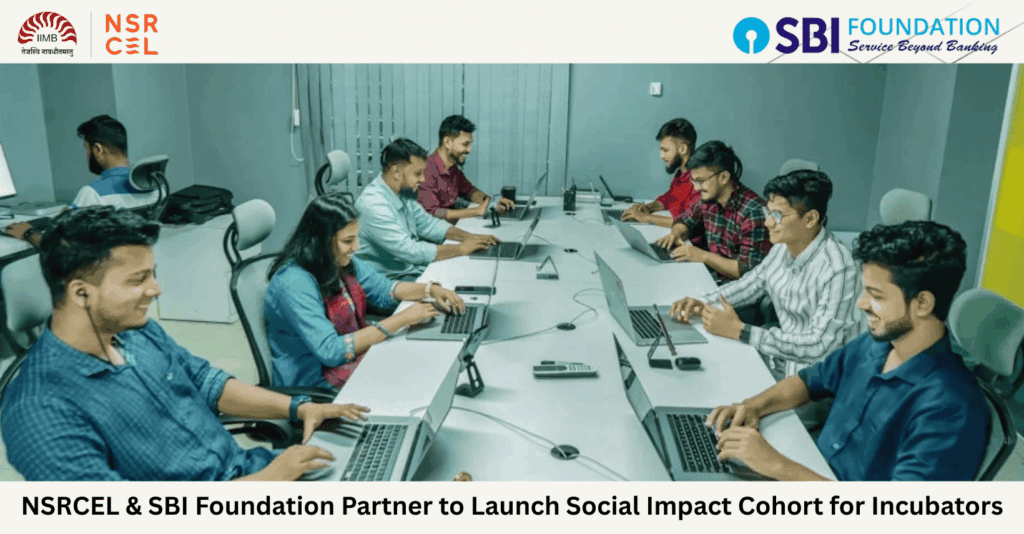
Most of the attention in India’s startup ecosystem over the past decade has gone toward the ventures themselves funding rounds, valuations, growth metrics. Less attention has gone to the institutions quietly supporting those ventures behind the scenes: the incubators. That’s the gap NSRCEL and SBI Foundation are trying to close with the second cohort of their joint capacity-building programme, aimed squarely at strengthening the incubators themselves rather than the startups passing through them.
It’s a fairly deliberate bet: that a stronger startup ecosystem in India’s smaller cities and regions depends less on any single funding round and more on whether the local institutions supporting founders are actually built to last.
What the iCube Initiative Is Actually Trying to Do
The IIM Bangalore NSRCEL iCube Initiative, short for “Incubating Incubators,” flips the usual accelerator model on its head. Instead of mentoring individual startups, it works directly with the incubators and institutions that support them on the idea that a generic, one-size-fits-all incubation model doesn’t hold up well once you factor in a region’s geography, sector mix, governance structure, or local entrepreneurial culture.
The second cohort builds on what the programme learned from its first, with more emphasis this time on institutional reflection and contextual problem-solving rather than a fixed playbook. Rasika Prashant, who took over as NSRCEL’s CEO in June 2026, framed the broader goal simply: the next challenge for India’s startup ecosystem isn’t building more incubators, but building ones robust enough to actually last, tailored to the specific conditions of each region rather than copied from a template.
Who's in the New Cohort
The newly launched Social Impact Cohort for Incubators brings together three institutions, each rooted in a different part of the country:
AIC MAGIC (Marathwada Accelerator for Growth & Incubation Council): Run under the Chamber of Marathwada Industries and Agriculture (CMIA), focused on grassroots industrial and agricultural innovation in the Marathwada region.
Incubation Centre, IIT Patna (IC IIT Patna): An academic incubation centre working on turning deep-tech and scientific research into commercially viable ventures.
The Tripura Institution for Transformation (TIFT): Focused on building out the entrepreneurial landscape across Northeast India, a region that’s historically had far less incubation infrastructure than the metros.
None of these three are based in Bengaluru, Delhi-NCR, or Mumbai, which is exactly the point. It gives founders in Marathwada, Bihar, and the Northeast a path to the same kind of institutional support that’s usually concentrated in a handful of metro hubs.
What the Program Actually Offers
The Incubation Training Program underneath this cohort isn’t a set of one-off webinars. It’s structured around three main pillars: access to a network of more than 110 mentors and industry experts who work directly with incubator leadership on operational challenges; a set of strategic frameworks and governance toolkits meant to sharpen day-to-day decision-making; and structured peer-to-peer sessions where incubators can borrow what’s working elsewhere and adapt it to their own region rather than starting from scratch.
The goal, in practice, is to help incubator leadership get better at spotting gaps in their own local ecosystem and, over time, attract stronger startups into their pipeline.
Why SBI Foundation Is Backing This
For SBI Foundation, this fits squarely into its broader mission of expanding entrepreneurship beyond India’s major cities. The programme runs under its SBI Foundation Innovators for Bharat initiative, specifically through the Livelihood and Entrepreneurship Acceleration Programme (LEAP).
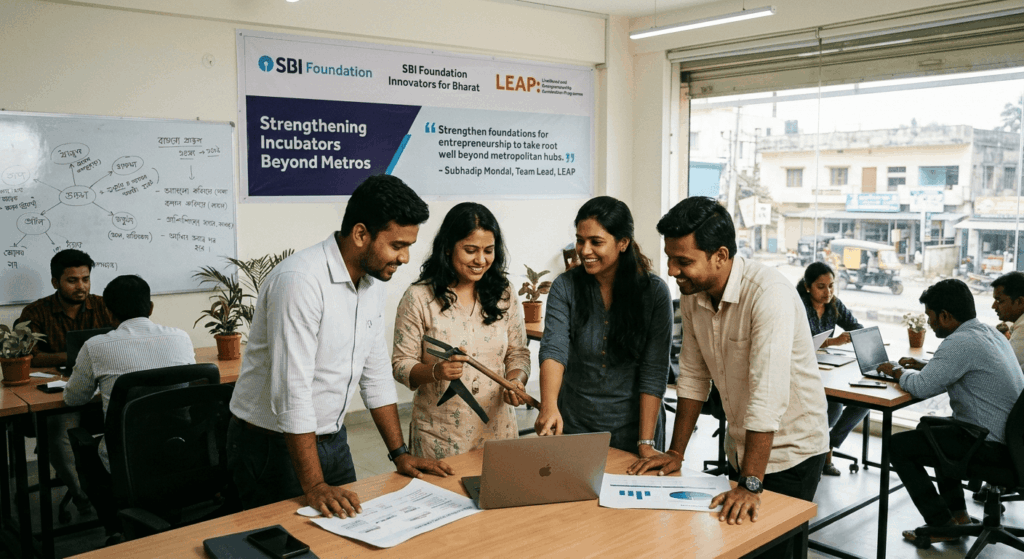
Subhadip Mondal, Team Lead for LEAP at SBI Foundation, has said the organisation’s goal is to strengthen the foundations that let entrepreneurship take root well beyond metropolitan hubs. Stronger incubation centres in tier-2 and tier-3 cities, the thinking goes, translate directly into more sustainable local livelihoods and more scalable businesses built around the specific economic challenges those regions actually face.
Part of a Bigger National Push
This isn’t happening in isolation. The work NSRCEL and SBI Foundation are doing here lines up with a broader national effort around Academic Incubation Capacity Building India one shared by NITI Aayog’s Atal Innovation Mission, the Department of Science and Technology, and the Ministry of Electronics and Information Technology.
The underlying idea is the same across all of these efforts: university and technical institutions shouldn’t just produce research papers; they should be capable of turning that research into real businesses. Building that capability inside academic institutions creates a steadier pipeline of innovation-driven ventures over time, which matters for regional economies and, cumulatively, for the country’s broader innovation output.
The Bigger Picture
India’s startup’s success story is shifting a little. It’s no longer just about how many incubators exist, but whether the ones that do exist are actually built to last. This second cohort from NSRCEL and SBI Foundation is a fairly clear bet on the idea that giving regional incubators the right frameworks, mentorship, and peer networks does more for the long-term health of India’s startup ecosystem than simply adding another accelerator to the map.
Frequently Asked Questions (FAQs)
1. What's the main goal of this partnership?
The core aim is to strengthen regional startup ecosystems by building up the incubators that support them, sharing operational frameworks, mentorship access, and best practices so those institutions can create lasting impact locally.
2. Which institutions are part of the new cohort?
Three institutions make up the second Social Impact Cohort for Incubators: AIC MAGIC (Marathwada Accelerator for Growth & Incubation Council), the Incubation Centre at IIT Patna, and The Tripura Institution for Transformation (TIFT), each representing a different regional innovation ecosystem.
3. How is this different from a typical startup accelerator?
Traditional accelerators work directly with individual startups. The IIM Bangalore NSRCEL iCube Initiative works one level up, training the incubator institutions themselves, with an emphasis on tailoring their approach to local geography, sector focus, and governance rather than applying a single fixed model.
4. What do participating incubators actually get access to?
Through the Incubation Training Program, incubators get a network of more than 110 mentors and industry experts, curated strategic frameworks and governance tools, and structured peer-to-peer sessions with other incubators in the cohort.
5. How does SBI Foundation fit into this?
Through its SBI Foundation Innovators for Bharat initiative and, specifically, its Livelihood and Entrepreneurship Acceleration Programme (LEAP), which funds and supports this kind of regional capacity-building work for incubators in tier-2 and tier-3 cities.
6. Why does academic incubation matter here?
Because universities and technical institutes are a natural source of deep-tech ventures. The push around Academic Incubation Capacity Building India echoed by NITI Aayog, DST, and MeitY, is about making sure that research doesn’t stay confined to campus labs, but has a real path into commercial, job-creating businesses.