


Villgro Launches MAP-Health Incubation Cohort to Scale MedTech Startups
- Blog Healthcare Industry New Startup Technology Trending News
- Entrepreneurs Story News
- August 17, 2026
- 717
- 16 minutes read
A lot of promising medical technology in India never really struggles with the invention part. It struggles with what comes after: getting a working device or diagnostic tool in front of the hospitals, clinics, and health systems that would actually use it. Villgro, one of India’s oldest social enterprise incubators, has opened a new cohort of its Villgro MAP-Health Incubation Cohort, a programme built specifically around that distribution problem rather than the product-development stage most incubators focus on.
MAP-Health, short for Market Access Partnerships for Healthcare, isn’t a brand-new idea from Villgro; the programme has been running since 2023. What’s new here is the next intake, aimed at connecting early- and growth-stage health ventures with clinical networks, distributors, and mentors who can actually get a product into use, not just funded.
Why Market Access Is the Real Bottleneck
India’s MedTech sector isn’t short on ideas or intellectual property. What early-stage teams routinely get stuck on is what happens after the prototype works: navigating hospital purchasing committees, public procurement, and the slow grind of building trust with institutional buyers. Most incubation programs are built around product development and early funding, and treat distribution as something to figure out later.
The premise behind Market Access Partnerships for Healthcare is to flip that order, treating distribution, procurement, and regulatory groundwork as core to the incubation process itself, not an afterthought once the product is technically ready.
This distinction matters because the two problems don’t respond to the same fixes. A funding gap can often be closed with a strong pitch and the right investor introduction. A distribution gap can’t it takes months of relationship-building with people who have no obligation to take a founder’s call, which is exactly the work most incubators aren’t structured to help with.
What Ventures Actually Get Out of It
Getting to Market, Not Just Getting Funded
A big part of the Villgro MedTech incubation track is straightforward go-to-market support: help with building a pricing strategy, unit economics, and a realistic plan for navigating hospital procurement, rather than guessing at it.
Real Clinical Pilots
Through Villgro’s existing channel relationships, cohort members get to run actual pilot projects within partner hospitals and health systems, which produce the kind of real-world validation data that’s genuinely hard to generate on your own, and that matters when you’re trying to scale MedTech startups beyond a single proof-of-concept site.
Help With the Regulatory Maze
Regulatory approval in India’s medical device space, covering CDSCO requirements, safety certifications, and clinical documentation, trips up a lot of early-stage founders who don’t have in-house regulatory expertise.
Mentors in the programme work directly with technical teams to help them get through that process without losing months to avoidable mistakes.
Who Should Apply
Villgro is looking for market-ready ventures rather than very early-stage concepts. Broadly, that means:
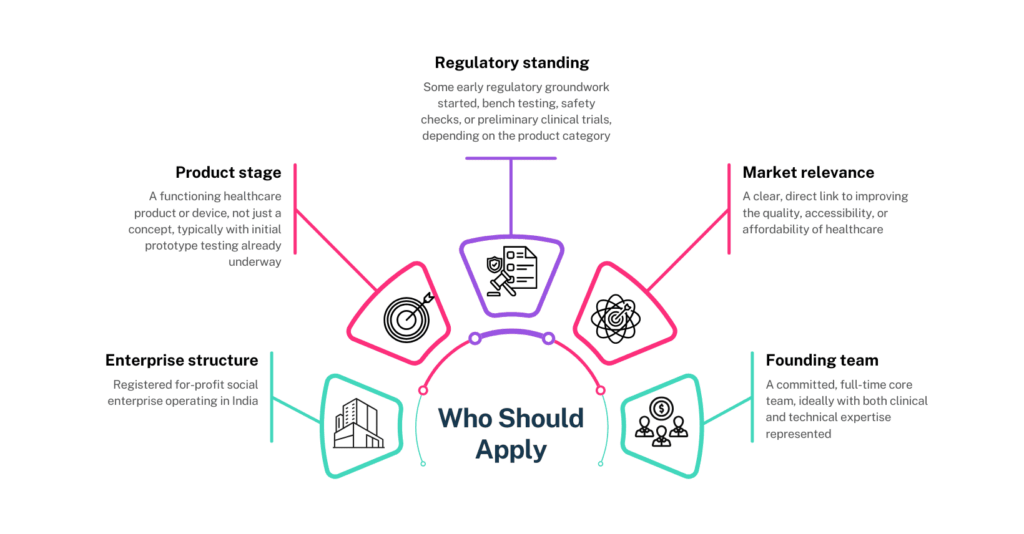
Selection Dimension | What’s Generally Expected |
Enterprise structure | Registered for-profit social enterprise operating in India |
Product stage | A functioning healthcare product or device, not just a concept, typically with initial prototype testing already underway |
Regulatory standing | Some early regulatory groundwork started, bench testing, safety checks, or preliminary clinical trials, depending on the product category |
Market relevance | A clear, direct link to improving the quality, accessibility, or affordability of healthcare |
Founding team | A committed, full-time core team, ideally with both clinical and technical expertise represented |
Ventures that fit this profile get access to Villgro’s existing commercial partnerships, which in practice tends to shorten the time it takes to go from a working prototype to an actual paying institutional customer.
Why This Matters Beyond Any One Cohort
Villgro, founded in 2001 and often described as India’s oldest social enterprise incubator, with more than 300 ventures backed to date, is essentially betting that the next wave of healthcare impact in India depends less on inventing more devices and more on actually getting the good ones into hospitals, clinics, and homes that need them.
If that bet pays off, the ripple effects go beyond any single cohort. Each new round of the Villgro MAP-Health Incubation Cohort adds another set of ventures with a real, tested channel into India’s healthcare system, which, over time, is what actually determines whether a promising diagnostic tool reaches a rural clinic or just stays a good idea on a lab bench.
Frequently Asked Questions (FAQs)
1. What is the goal of the Villgro MAP-Health Incubation Cohort?
It’s designed to help health-focused social enterprises get past the hardest part of scaling not building the product, but actually getting it adopted by hospitals, clinics, and distribution networks across India.
2. What does “MAP” stand for?
Market Access Partnerships for Healthcare. It’s a framework built specifically around connecting MedTech developers with institutional healthcare buyers and distribution networks.
3. How does the MAP-Health incubation program actually help ventures grow?
The MAP-Health incubation program provides structured clinical pilot sites, regulatory guidance, go-to-market support, and milestone-based funding all aimed at reducing the risk institutional buyers see in adopting a new health technology.
4. Is this a brand-new Villgro program?
No, MAP-Health has been running since 2023. This is a new cohort within an established programme, not a first-time launch.
5. Who typically funds or scouts ventures coming out of this cohort?
Early-stage healthcare investors and impact funds that focus specifically on healthcare startup incubation in India tend to watch these cohorts closely, since a completed pilot is exactly the kind of validation they look for before writing a check.
6. What does success look like for ventures in this program?
In practical terms, it means moving from a working prototype to real institutional adoption the whole point of the effort to scale MedTech startups through structured market access rather than leaving founders to build hospital relationships from scratch.
7. What kind of support does the Villgro MedTech incubation team provide for clinical pilots?
The Villgro MedTech incubation team connects startups with partner hospitals, community clinics, and NGO health networks to run structured pilots that generate the clinical and commercial evidence investors and buyers actually want to see.