

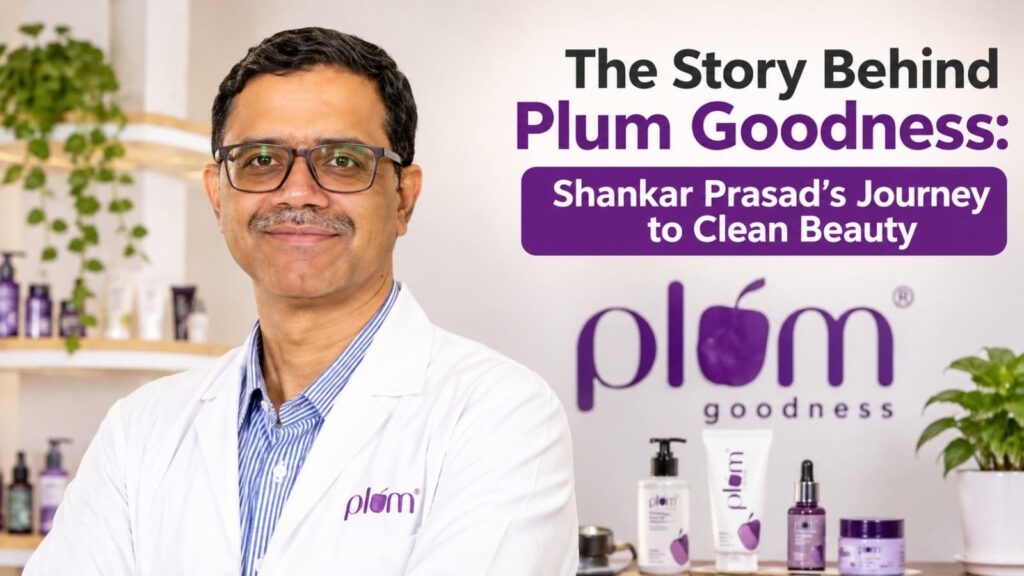
The Story Behind Plum Goodness: Shankar Prasad’s Journey to Clean Beauty
- Blog Industry Startup Success stories
- Entrepreneurs Story News
- October 31, 2026
- 16
- 22 minutes read
Most people don’t quit a secure, senior job at 38 to start something from scratch. Shankar Prasad did. After more than 15 years at Hindustan Unilever, McKinsey and a private equity firm, he put his own savings into a small beauty brand that he ran from a two-room apartment. That brand became Plum Goodness, one of India’s best-known vegan beauty names.
His story is not about sudden luck. It’s about a chemical engineer who spent years learning how products are made, how businesses work, and what customers really want, and then used all of it to build something of his own. At a time when shoppers had started asking whether a manufacturer tested on animals or what went into a bottle, he was ready with an answer.
Humble Beginnings of his life
Prasad grew up in Chennai in the years before India opened up its economy. His family lived on a household income of roughly ₹5,000 a month. Money was tight, and so was supply. He remembers that his family needed a prepaid “milk card” just to be sure of getting milk every day.
He has described that period as one that was “as well supply constrained as it was income constrained.” Growing up this way taught him the value of every rupee, a lesson that would shape how he later ran his own company.
Education: IIT Bombay and ISB
He studied Chemical Engineering at IIT Bombay, where he says he was a class topper. The subject gave him a deep understanding of how products are formulated and made at scale, knowledge that later became Plum’s biggest strength.
Years later, he went to the Indian School of Business (ISB), Hyderabad, for his MBA, graduating with the Class of 2006. He has spoken warmly about it: “I wouldn’t be where I am if I had not come to ISB.” His favourite memory? Learning “how to make a balance sheet, profit and loss (P&L), and cash flow.” For an engineer, that business Education completed the picture.

Learning on the Factory Floor at HUL
After IIT, he joined Hindustan Unilever (HUL) and spent nearly eight years there. Interestingly, what drew him to HUL was a brochure showing an ice cream production line, which he thought looked “fun”.
He started in hardcore manufacturing and later moved to product development, mainly in soaps and detergents. He worked on an 80,000 tonnes-per-year soap line and won an Asia innovation award while at the company.
Those years taught him how to get a formula right “first time” and how to scale it up. “Many of the principles are still applicable,” he has said about his HUL training.
McKinsey and Everstone: Learning to Run a Business
After ISB, Prasad joined McKinsey, where he continued to focus on consumer goods. He then moved to the private equity firm Everstone, working with its portfolio companies.
When Everstone took a majority stake in the cosmetics brand Faces Canada, he helped run and scale its India business, and he even “carried a chief operating officer (COO) card” for one of the portfolio companies.
This was where he learnt the retail side of beauty: training and motivating beauty advisors, managing stock and understanding colour cosmetics.
He also learnt that simply importing foreign shades wouldn’t work for Indian skin tones. In his words, it gave him “invaluable learning on running a consumer company from the ground up.” Few entrepreneurs start with this kind of all-round preparation.
Starting Plum at 38!
At 38, Prasad decided it was time to build something of his own. His reason was simple: he wanted “to add goodness to this world.” He felt Indian shoppers lacked “a science-driven approach to natural beauty”.
Why beauty? His years with Faces Canada had shown him a clear gap. Indian shoppers wanted gentle, effective and ethical products, but most options were either harsh mass-market brands or expensive imports. As a chemical engineer who had worked on formulations, he knew he could make good products at fair prices.
The early days were tough and very frugal:
- Own money: He funded the business with his Provident Fund savings.
- Small office: For the first four years, the team worked out of a two-room apartment.
- No salary: He didn’t pay himself for more than three years.
- Strict spending: A “least count” rule meant even ₹1,000 expenses were carefully checked.
The company, Pureplay Skin Sciences, was set up in 2013, and Plum took its first online order on 14 July 2014. It started with skincare on a simple Shopify website. Even marketing was tested on a shoestring; the first Facebook ad experiment had a budget of just ₹100. Plum became profitable by 2016.
The Plum Goodness Brand Story in Brief

Under his leadership, Plum grew one careful step at a time:
- 2014: First order on its own website.
- 2016: Became profitable.
- 2018: PETA-approved as vegan and cruelty-free.
- Later years: Expanded into haircare, body care (BodyLovin’), makeup and men’s care.
- FY2026: Revenue of ₹515 crore and a profit of ₹49 crore.
Plum D2C Beauty Strategy: The Founder's Approach
The Plum D2C beauty strategy reflects Prasad’s own habits. He reads customer reviews every day and personally follows up on complaints. Selling directly through its own website gave Plum quick feedback on what worked and what didn’t.
The brand grew from its website to marketplaces and then to physical stores. Today, sales are roughly half online and half offline. At its heart, the Plum D2C beauty strategy is about one thing he believes strongly: “Customer view is the only view that matters. My view doesn’t matter.”
Plum Sustainability Commitment
The Plum sustainability commitment began with values Prasad built in from day one: every product is 100% vegan, and the brand has been PETA-approved as cruelty-free since 2018.
Through its Empties4Good programme, customers can return empty bottles for recycling and get ₹50 in credits for each one. Some of these empties are even turned into shelters for stray dogs. The Plum sustainability commitment shows his belief that a good business should also do good.
His Thinking on Funding
Prasad has always been careful with outside financing. He bootstrapped for the first few years and then raised money in stages: a Series A from Unilever Ventures in 2018, a ₹110 crore Series B led by Faering Capital in 2020, and a $35 million Series C led by A91 Partners in 2022. In total, Plum has raised a little over $50 million.
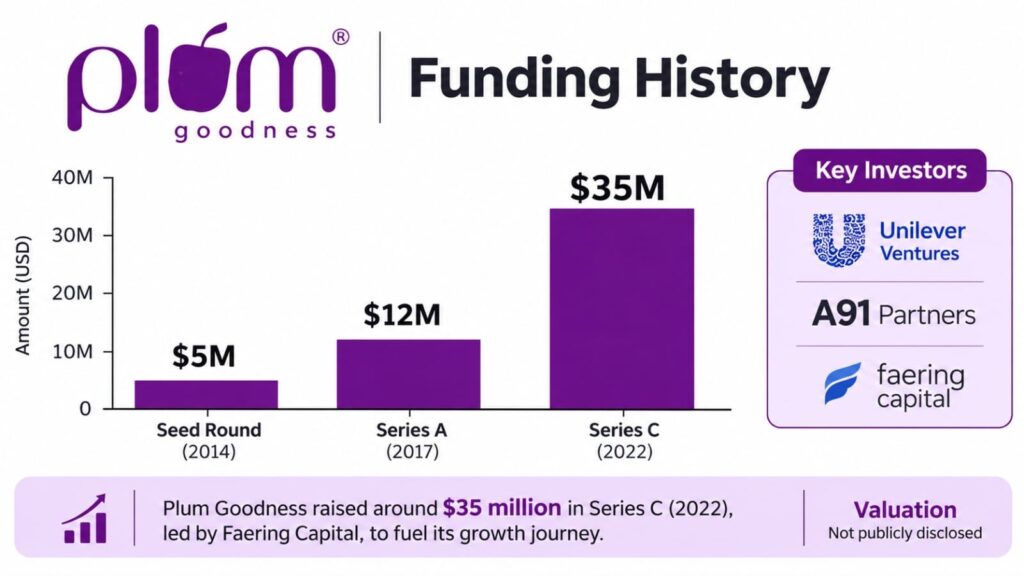
His view on Funding is clear: “I look at capital as an input into the business rather than an end in itself.” That mindset helped Plum turn an ₹84 crore loss in FY2024 into back-to-back profits.
Leadership Style
- Obsessed with quality: “Consumers appreciate the difference between a 99 and a 95,” he says. He was closely involved in product formulations.
- Frugal by habit: Spend only what’s needed, even when money is available. It’s a lesson from his Chennai childhood.
- Simple structure: Plum keeps a lean setup, about five levels deep, with around 140 field staff, and outsources technology development.
- Ambitious but grounded: He calls himself “the most aggressive” in sales meetings, yet believes “biggest is not necessarily the best.”
Quick Facts at a Glance
Category | Details |
Name | Shankar Prasad |
Role | Founder & CEO, Plum (Pureplay Skin Sciences) |
Grew up in | Chennai |
Education | B.Tech Chemical Engineering, IIT Bombay; MBA, ISB Hyderabad (Class of 2006) |
Career | Hindustan Unilever (~8 years) → McKinsey → Everstone (Faces Canada) |
Award | Asia innovation award at HUL |
Started Plum | At 38; company set up in 2013; first order 14 July 2014 |
Starting capital | His own Provident Fund savings |
Plum funding | $50M+ (Unilever Ventures, Faering Capital, A91 Partners) |
Plum FY2026 | Revenue ₹515 crore; profit ₹49 crore |
Lessons From His Journey
- It’s never too late. He started at 38 and built a profitable ₹500 crore brand.
- Prepare well. Factory, consulting and private equity experience gave him every skill he needed.
- Respect every rupee. A frugal start made the company stronger, not weaker.
- Listen to customers. Reading reviews daily kept Plum close to what people wanted.
Conclusion
From a ₹5,000-a-month household in Chennai to building one of India’s leading vegan beauty brands, Shankar Prasad’s journey shows what patience, preparation, and purpose can achieve.
The Plum Goodness brand story reflects its founder’s values: quality, honesty, and care for customers. That’s why it continues to inspire.
Frequently Asked Questions (FAQ's)
1. Who founded Plum Goodness?
Plum was founded by an IIT Bombay and ISB graduate who previously worked at Hindustan Unilever, McKinsey, and Everstone. He is its Founder and CEO.
2. How old was he when he started Plum?
About 38.
3. How did he fund Plum at first?
With his own Provident Fund savings. He didn’t take a salary for more than three years.
4. Where did he grow up?
In Chennai, in a family with a modest income of about ₹5,000 a month.