


The End of a 40-Year Joint Venture: Disney and Hearst Part Ways on A+E
- Blog Entertainment Industry New Trending News
- Entrepreneurs Story News
- August 7, 2026
- 564
- 13 minutes read
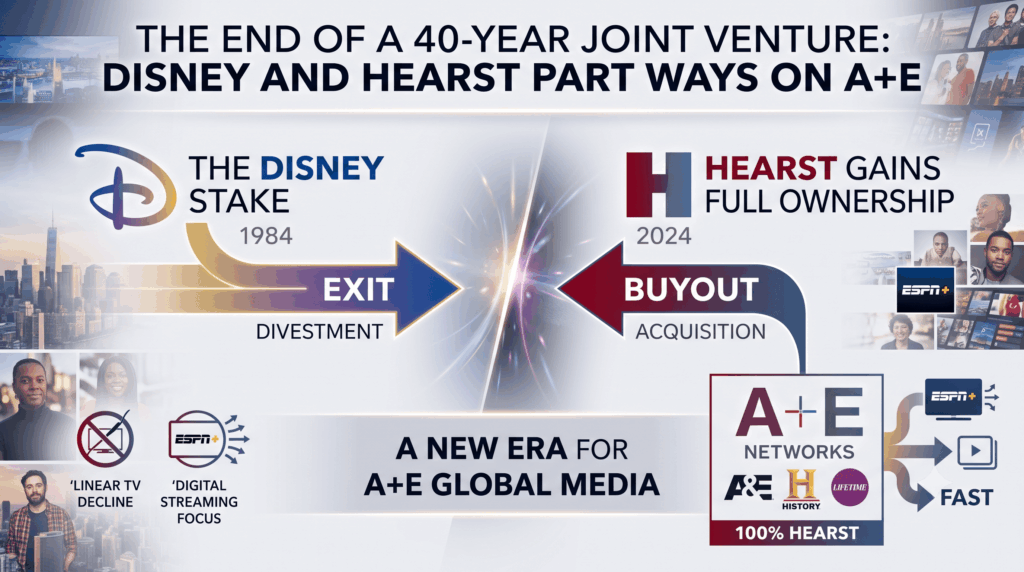
The Walt Disney Company has agreed to sell its 50% stake in A+E Global Media to longtime partner Hearst Communications, in an all-cash deal reportedly worth about $1.2 billion. Once the transaction closes, expected in September 2026, Hearst will own A&E Network, the History Channel, Lifetime, and the rest of the A+E portfolio outright for the first time in the company’s history.
A+E traces back to 1984, when the Alpha Repertory Television Service merged with The Entertainment Channel to form A&E Network. For its first two decades, it was actually a three-way partnership among ABC (later folded into Disney), Hearst, and NBCUniversal. NBCUniversal sold its roughly 15.8% stake to Disney and Hearst in 2012, which is when the company settled into the even 50/50 split that has defined it for the past decade-plus. That structure is now coming to an end.
A Long Partnership, Reaching a Natural Endpoint
Under Disney and Hearst’s joint stewardship, A+E grew from a single cable channel into a sprawling media company that includes A&E, History, Lifetime, FYI, Lifetime Movie Network, a stake in Vice TV, and the production arm A+E Studios. The business rode the cable boom of the 1990s and 2000s and, unusually for a legacy TV company, remains profitable and debt-free today.
But linear television’s economics have changed. Cord-cutting has accelerated, ad dollars keep shifting to streaming and programmatic platforms, and media companies across the board are re-examining which legacy assets are still worth owning jointly. Disney and Hearst quietly explored a sale as far back as July 2025, retaining Wells Fargo to run the process; Starz reportedly looked at the business before talks with Hearst advanced. The move away from A+E, in that sense, is less a falling-out than two companies with increasingly different priorities agreeing it’s time to go their separate ways on this particular asset.
Why Disney Is Selling
For Disney, offloading its A+E stake fits a broader pattern of shedding non-core linear assets to focus capital and management attention on streaming. It’s also the first major divestiture under new Disney CEO Josh D’Amaro, and analysts have suggested it may not be the last. Rich Greenfield of Light Shed Partners, who first reported the deal, has said he’d “love to see Disney completely exit linear TV.”
The financial picture helps explain the timing. In its 10-Q filing for the quarter ended March 2026, Disney listed its A+E investment at a carrying value of roughly $2 billion and took a $147 million impairment charge against it. Selling now, at an all-cash price of about $1.2 billion, gives Disney a clean exit and immediate liquidity it can redirect toward Disney+, Hulu, and especially the continued build-out of ESPN’s direct-to-consumer platform.
The Deal Terms
The agreement is an all-cash transaction valued at roughly $1.2 billion, reportedly struck at a relatively low EBITDA multiple given the state of the linear TV market. It’s expected to close alongside or shortly after Disney’s fiscal third-quarter earnings report. Once it closes, Disney will have no remaining equity interest in A+E Global Media.
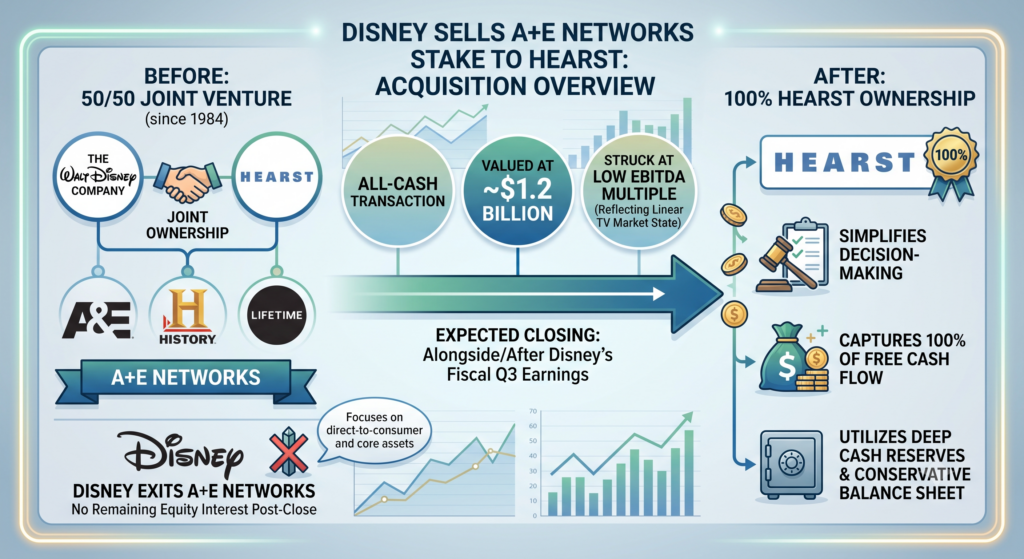
For Hearst, a privately held company known for its conservative balance sheet and deep cash reserves, buying out its partner is a straightforward way to simplify decision-making and capture 100% of A+E’s free cash flow going forward rather than splitting it and negotiating every major call with a joint-venture partner.
What Changes for A+E
Day-to-day programming isn’t expected to shift much in the near term. Paul Buccieri stays on as president and chairman of A+E Global Media, now reporting to Hearst president and CEO Steven R. Swartz instead of a Disney-Hearst board split down the middle.
A+E has been an early mover into FAST (free ad-supported streaming TV) channels, a model well suited to its deep library of true-crime, docuseries, and reality programming, and one that doesn’t depend on traditional cable carriage fees the way linear TV does. Full Hearst ownership should make it easier for A+E to license that content freely, without needing sign-off from a partner that’s also competing for streaming subscribers.
What It Signals for the Wider Industry
A+E’s sale adds to a growing list of legacy media companies rethinking how much linear TV they want to hold onto. Comcast has already spun off much of its cable portfolio into a separate company; Warner Bros. Discovery and Paramount are watched closely for similar moves. As streaming continues to eat into cable’s economics, deals like this one a profitable, debt-free asset changing hands for roughly $1.2 billion may become more common rather than less.
For Disney, the deal frees up capital and simplifies its portfolio. For Hearst, it’s a chance to fully own a media business it already knows intimately. And notably, the two companies aren’t severing ties altogether: Disney remains the majority owner of ESPN at roughly 72%, with Hearst still holding an 18% stake a reminder that this is a realignment around one specific business, not a full corporate divorce.
Frequently Asked Questions (FAQs)
Why are Disney and Hearst splitting up A+E?
Mainly because their priorities have diverged. Disney wants to concentrate capital and management focus on streaming, particularly Disney+, Hulu, and ESPN’s DTC transition, and has decided a 50% stake in a linear-heavy cable business no longer fits that plan. Hearst, by contrast, wants full control of a business it considers a strong, stable earner.
How much is Hearst paying?
The deal is reported as an all-cash transaction worth approximately $1.2 billion, funded from Hearst’s own cash reserves.
Will A&E, History, and Lifetime change for viewers?
Not immediately. Programming and day-to-day operations are expected to continue largely as-is, with Paul Buccieri remaining in charge, now reporting solely to Hearst leadership.
What does Hearst get out of full ownership?
Full control over a profitable, debt-free media company, all of its free cash flow, and the ability to license A+E’s programming library to outside streamers without needing agreement from a joint-venture partner.
Are Disney and Hearst completely done doing business together?
No. The two remain co-owners of ESPN, with Disney holding roughly 72% and Hearst 18%. The A+E sale is a realignment of one specific joint venture, not a full separation between the companies.