

Zepto, IndiGo, BookMyShow, PW among 9 other apps fined: Full List of Apps Using Dark Patterns
- Blog Industry New Startup Technology Trending News
- Entrepreneurs Story News
- August 7, 2026
- 554
- 13 minutes read
Zepto, IndiGo, BookMyShow, PhysicsWallah and six other platforms have been pulled up by India’s consumer regulator for using manipulative app and website design the kind that nudges you into paying more, signing up for things you didn’t mean to, or feeling guilty for saying no. The government disclosed the enforcement action in a written reply to the Rajya Sabha on August 5, revealing that the Central Consumer Protection Authority (CCPA) has collected close to ₹20 lakh in penalties from nine companies found violating India’s dark pattern rules.
For anyone running a digital product compliance teams, UX designers, founders this is worth reading closely. It’s the clearest signal yet that the CCPA’s 2023 guidelines aren’t just sitting on paper anymore. Here’s who was fined, what they did wrong, and what it means going forward.
What counts as a dark pattern, according to the CCPA
The rules in question are the Prevention and Regulation of Dark Patterns Guidelines, 2023, which spell out 13 specific manipulative design practices that companies aren’t allowed to use. A few that show up repeatedly in this round of penalties:
- Basket sneaking: adding items, memberships, or donations to your cart without asking
- Drip pricing: hiding part of the final cost a handling fee, say until the last step of checkout
- Confirm shaming: guilt-tripping language designed to talk you out of opting out of something
- False urgency: countdown timers or scarcity claims that aren’t real
In June 2025, the CCPA followed up with an advisory ordering e-commerce platforms to run self-audits and clean up their interfaces within three months. Nine platforms didn’t get there in time or weren’t caught until after.
The nine platforms, and what they were fined for
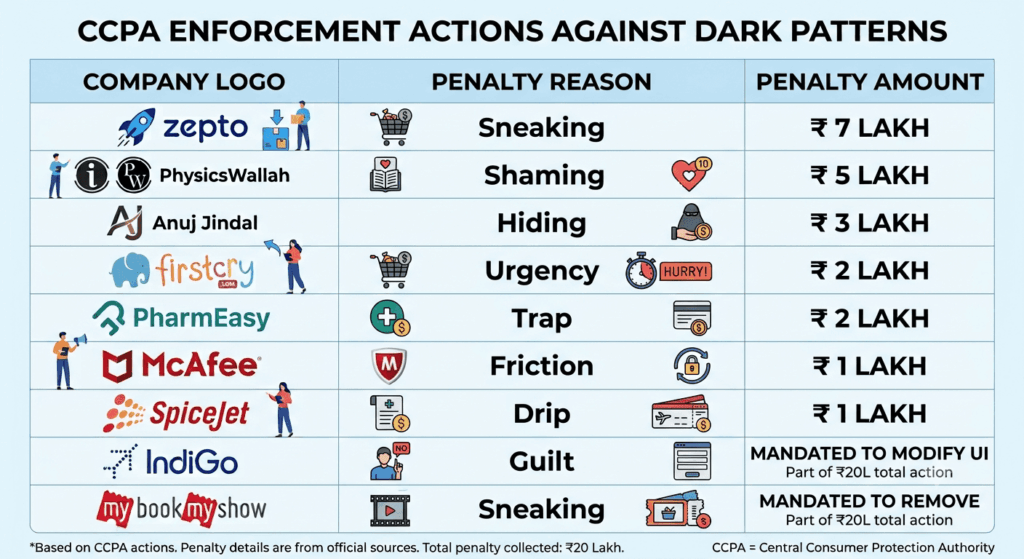
- Zepto — ₹7 lakh
The largest penalty in this batch went to the quick-commerce app. The CCPA found that Zepto’s checkout was quietly tacking on a handling charge and a membership fee that weren’t part of the price a shopper first saw — the handling fee was treated as drip pricing, the membership add-on as basket sneaking. Zepto has since dropped both practices.
- PhysicsWallah (PW) — ₹5 lakh
The edtech company was fined after the CCPA looked into a pre-ticked ₹10 donation to the “PW Foundation” sitting inside its checkout flow, plus emotionally loaded messaging that discouraged users from unchecking it. Users were also asked to hand over personal details just to access supposedly free courses. PW has paid the fine and removed the flagged practices.
- Anuj Jindal — ₹3 lakh
This coaching platform was penalised for obscured charges and misleading promotional layouts that made it hard for users to understand what they were actually paying for.
- FirstCry — ₹2 lakh
The baby-products retailer was fined for fake countdown timers and forced subscription add-ons that pushed shoppers toward quick, uninformed purchases.
- PharmEasy — ₹1 lakh
Hidden charges and subscription renewal prompts made it unnecessarily difficult for users to manage or cancel recurring services on the pharmacy platform.
- McAfee — ₹1 lakh
The cybersecurity company’s auto-renewal flow was found to be deliberately frictionful the CCPA said it was unreasonably hard for Indian users to cancel subscriptions once enrolled.
- SpiceJet — ₹1 lakh
The airline was fined for drip pricing ancillary charges that only appeared at the very end of the booking process, after a customer had already compared and chosen a fare.
- IndiGo
IndiGo wasn’t fined monetarily but was ordered to fix its app after complaints about confirm shaming. When users tried to decline an add-on travel-protection option, the app displayed the message “No, I will take risk” language designed to make opting out feel reckless. Following the CCPA’s intervention, IndiGo changed the wording to the neutral “No, I will not add to the trip.”
- BookMyShow
The ticketing platform was directed to remove a pre-selected ₹1 contribution to its BookASmile charity initiative from the checkout flow a textbook basket-sneaking case, even at a token amount. BookMyShow has since switched the donation to an opt-in model.
Between them, the seven monetary penalties add up to the ₹20 lakh figure the government cited ₹7L + ₹5L + ₹3L + ₹2L + ₹1L + ₹1L + ₹1L with IndiGo and BookMyShow facing compliance directives rather than fines.
Why this matters beyond these nine companies
The spread here is the real story: quick commerce, edtech, aviation, cybersecurity, pharmacy, ticketing. There’s no industry exemption. If your product has a checkout flow, a subscription, or an opt-out button, this framework applies to you.
Practically, that means auditing pre-ticked boxes, checking whether your final price matches what a user saw first, and rereading the copy on every “no thanks” or “cancel” button for language that pressures rather than informs. The Consumer Protection Act now treats these as enforceable offences, not just bad UX and regulators are clearly willing to act on complaints, not just wait for self-reported audits.
Frequently Asked Questions (FAQs)
Which apps were fined by the CCPA for dark patterns?
Zepto, PhysicsWallah, Anuj Jindal, FirstCry, PharmEasy, McAfee, and SpiceJet were fined amounts ranging from ₹1 lakh to ₹7 lakh. IndiGo and BookMyShow weren’t fined but were ordered to redesign specific parts of their apps.
How much money did the CCPA collect in total?
Close to ₹20 lakh, according to the government’s written reply to the Rajya Sabha.
What exactly is a "dark pattern"?
It’s a design choice in an app, website, or checkout flow built to steer users toward decisions they wouldn’t otherwise make, whether that’s an extra charge, an unwanted subscription, or an automatic opt-in they never noticed.
Where do these rules come from?
The Prevention and Regulation of Dark Patterns Guidelines, 2023, list 13 prohibited practices. A follow-up CCPA advisory in June 2025 gave e-commerce platforms three months to self-audit and fix any violations.