


Why CMOs Are Quietly Shifting Budget Away from Paid Ads and Toward Their Own Data
- Blog Industry Marketing New Technology Trending News
- Entrepreneurs Story News
- August 10, 2026
- 633
- 15 minutes read
For most of the last decade, digital advertising was the default growth engine. Brands poured money into platforms owned by someone else, rented access to huge audiences, and let the algorithms do the targeting. That’s starting to change. A growing number of CMOs are rethinking how much they want to depend on ad platforms they don’t control and putting real budget behind building their own data and their own owned channels instead.
Rising customer acquisition costs are a big part of why. So is a broader shift in how companies think about the audience data they rely on: owning it directly, rather than renting access to it one campaign at a time.
What's Actually Driving This
The frustration is straightforward. Brands have spent years paying a premium for access to audiences on platforms they never controlled. As ad space has gotten more competitive, costs have climbed while results have gotten harder to predict and harder to explain to a CFO asking why return on ad spend keeps flattening out.
Privacy regulation is the other half of the story, though it’s a messier picture than it’s often made out to be. GDPR and CCPA have permanently raised the bar for how companies are allowed to collect and use customer data. On the browser side, though, the shift away from third-party cookies has been uneven rather than sweeping.
Safari and Firefox already block third-party cookies by default. Chrome which still runs roughly two-thirds of the world’s browsers actually reversed course: Google abandoned its plan to phase cookies out back in July 2024, and confirmed in 2025 that it wasn’t going to force the issue after all. Third-party cookies are still on by default in Chrome today; users just have the option to turn them off.
So, brands aren’t dealing with cookies disappearing overnight; they’re dealing with a patchwork where roughly half the web already behaves as if cookies are gone, and the other half hasn’t caught up. Either way, betting a data strategy on rented, third-party tracking looks increasingly shaky.
Why First-Party Data Is Becoming the Real Asset
First-party data is simply the information a company collects directly from its own customers purchase history, site behavior, support interactions, subscription details. Because it comes straight from the source, it’s more accurate, more relevant, and it doesn’t carry the same privacy baggage as data bought from a third party.
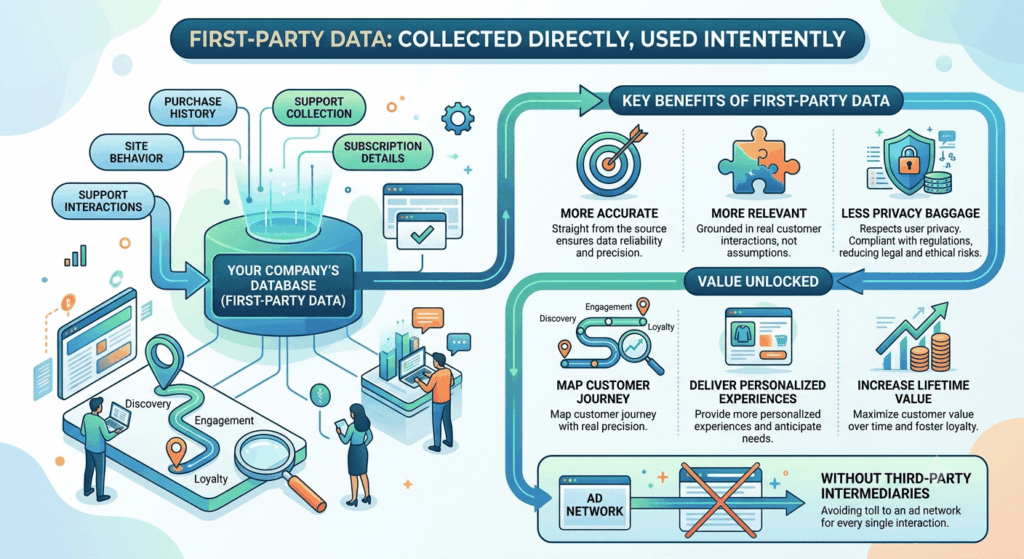
Done well, it lets a company map the customer journey with real precision delivering more personalized experiences, anticipating what customers need next, and increasing lifetime value, all without paying a toll to an ad network for every single interaction.
Zero-Party Data: Skipping the Guesswork
There’s a related idea worth separating out: zero-party data, a term Forrester Research coined a few years back. Where first-party data is largely inferred from behavior what someone clicked, what they bought zero-party data is information customers hand over voluntarily and on purpose: preference settings, quiz answers, direct feedback, account customizations.
Folding zero-party data into a broader first-party strategy lets a company skip the guesswork entirely and just ask customers what they want. That kind of transparent trade customers share information, brands offer something genuinely useful in return tends to build more trust than inferring intent from behavior alone, and it insulates the relationship from whatever a third-party platform decides to change next.
Where the Customer Data Platform Fits In
Collecting all this data is only half the job; the harder part is actually using it. That’s the gap a customer data platform, or CDP, is built to close. It pulls together information from scattered sources CRM records, e-commerce transactions, app usage, point-of-sale data, email activity into one unified, real-time customer profile.
A good CDP breaks down the walls between departments that are often sitting on the same customer without realizing it, and lets marketing teams run coordinated, targeted campaigns across channels instead of working off five different spreadsheets. The more advanced platforms also use machine learning to get ahead of purchasing behavior rather than just reporting on it after the fact. For any company serious about scaling a first-party data approach, some version of this infrastructure isn’t optional it’s the plumbing everything else runs on.
The Comeback of Owned Media
None of this works without somewhere to actually collect the data, which is part of why owned media is having a moment again. Unlike a social media page, where an algorithm change can quietly tank your reach overnight, owned media a company’s website, app, email list, podcast, community forum is fully within the brand’s control.
Investing in owned channels builds something that compounds over time. Strong content earns organic search traffic. Interactive tools, useful gated content, and genuinely valuable resources give customers a reason to share information willingly. And gradually, brands that lean into this end up with a direct line to their audience that doesn’t depend on a rented platform’s goodwill which cuts reliance on paid media and builds something that’s actually worth more the longer it exists.
Where to Start
For marketing leaders looking to make this shift real rather than aspirational, a few steps tend to matter most:
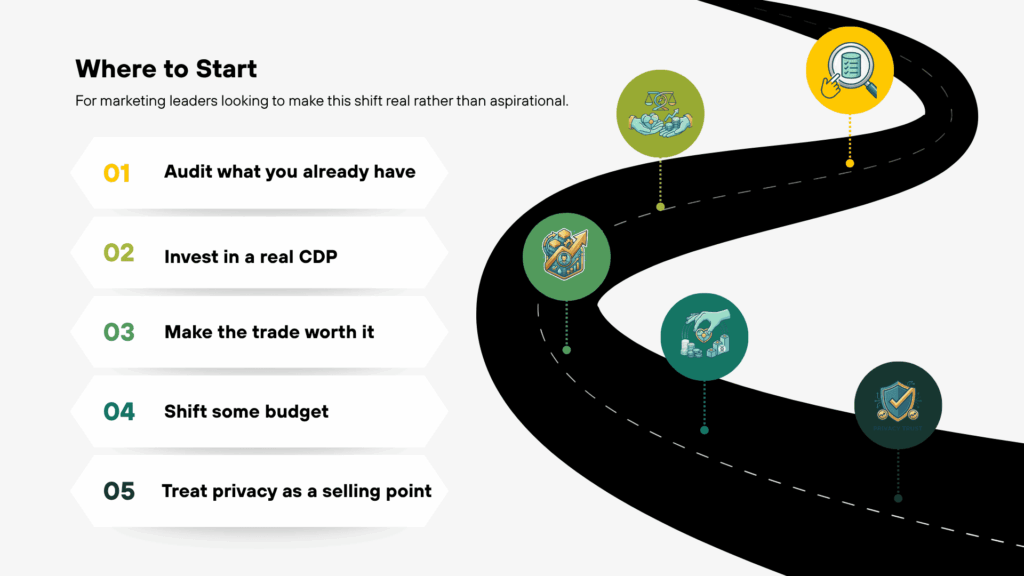
- Audit what you already have. Look at how data is currently being collected across departments, and check it against current privacy rules and the reality of a mixed cookie landscape rather than an assumed cookie-less one.
- Invest in a real CDP. Bring the marketing stack together so sales, IT, and marketing are working off the same customer picture instead of separate ones.
- Make the trade worth it. Give customers a real reason to share zero-party data early access, better recommendations, genuinely useful content rather than asking for information with nothing offered in return.
- Shift some budget toward owned channels. Not all at once, but steadily building assets that keep paying off instead of renting attention one campaign at a time.
- Treat privacy as a selling point, not a chore. Being upfront about how data is collected and used builds trust that a purely behavioral, third-party approach can’t.
The Bottom Line
The era of pouring an ever-growing budget into rented audiences is losing its shine not because paid ads stopped working, but because the returns have gotten harder to justify and the ground underneath third-party tracking keeps shifting, unevenly, browser by browser. Companies leaning into first-party data and owned media aren’t necessarily abandoning paid advertising. They’re just making sure they’re not entirely dependent on it building something they actually own, rather than renting all of it from platforms that can change the terms whenever they want.
Frequently Asked Questions (FAQs)
1. What is a first-party data strategy, and why does it matter now?
It means collecting and using data straight from your own audience site behavior, purchases, email engagement instead of buying it from outside vendors. It matters more now because privacy regulation has tightened and third-party tracking has become less reliable across different browsers, even if that shift hasn’t been as uniform as often assumed.
2. Does owned media actually help with rising ad costs?
Indirectly, yes. Channels a brand fully controls its site, app, email list let it reach an audience without paying a platform for every interaction, which over time takes some of the pressure off a rising cost-per-acquisition.
3. What's the difference between first-party and zero-party data?
First-party data is mostly inferred from behavior what someone browsed or bought. Zero-party data is information a customer deliberately hands over, like quiz answers, a survey response, or account preferences.
4. Why do companies need a customer data platform?
Because data scattered across a dozen systems isn’t useful on its own. A CDP pulls it into one unified customer view, which is what makes personalized, real-time marketing campaigns actually possible at scale.
5. Do brands need to give up on paid advertising entirely?
No, the point isn’t to abandon paid ads; it’s to rely on them less. A stronger first-party data foundation typically makes the paid campaigns a company runs more efficient through better targeting and audience matching.