


Indian Auto Market Surges in July 2026: Passenger Vehicle Sales Record Double-Digit Growth
- Blog Automobile Industry New Trending News
- Entrepreneurs Story News
- August 7, 2026
- 522
- 14 minutes read

Indian Auto Market closed out July 2026 on a high, with automakers dispatching 4,63,249 units to dealerships nationwide, up 33.6% from the 3,46,669 units moved in July 2025, and up 18.2% from June’s 3,91,968 units. It’s the strongest July the industry has ever recorded, and it comes right as manufacturers start stocking up for the festive season.
What's Behind the Jump
Part of this is simply timing. With Onam and Varamahalakshmi kicking off the festive calendar in South India, OEMs have been building dealer inventory ahead of the typical demand spike that follows. That alone explains a good chunk of the sequential jump from June.
But there’s a second, more specific story behind July’s numbers: recovery. Hyundai and Kia both had a rough June after a fire at a supplier’s facility disrupted production. Hyundai alone lost an estimated 13,900 units of output that month. By July, both companies were back to normal, and Hyundai’s domestic sales jumped roughly 37% month-on-month as a result, hitting an all-time high of 54,210 units.
On top of that, new model launches gave individual brands a real lift: Nissan’s wholesales more than tripled year-on-year to 4,518 units after it began customer deliveries of the new Tekton in July, and Kia notched its best-ever July with 28,200 units on the back of strong Seltos and Sonet demand. Favourable financing conditions and the lingering benefit of last year’s GST rate cuts on vehicles rounded out a genuinely strong month, rather than one driven by any single factor.
Maruti Suzuki Pulls Further Ahead
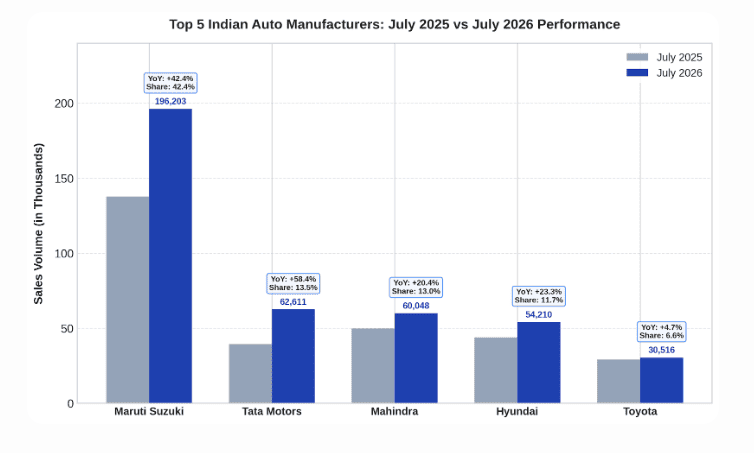
Maruti Suzuki had the standout month. The company dispatched 1,96,203 units, just short of the 2-lakh mark, a 42.4% jump from July 2025’s 1,37,776 units. That pushed its market share to 42.4%, up from 39.7% a year earlier, and Maruti alone accounted for roughly 42% of the industry’s entire year-on-year volume gain, a sign of just how broad its hatchback, compact SUV and utility vehicle lineup has become.
A Tight Race for Second
Behind Maruti, the fight for second place stayed close. Tata Motors held onto the runner-up spot with 62,611 units, up a sharp 58.4% year-on-year, helped by strong EV demand and its safety-focused ICE lineup. Mahindra wasn’t far behind at 60,048 units, up 20.4%, powered as usual by its SUV-heavy portfolio. The gap between the two: just 2,563 units.
Hyundai, Toyota and the Rest of the Field
Hyundai’s rebound landed it at 54,210 units, a 23.3% year-on-year increase and its best-ever July. Toyota Kirloskar Motor held fifth place with 30,516 units, up a more modest 4.7%, continuing to lean on its hybrid and utility vehicle range. Further down the list, Nissan was the volume story of the month, and Kia quietly posted its best July on record both signs that growth in July wasn’t confined to the top of the table.
July 2026 Snapshot: Top 5 Manufacturers
|
Rank |
OEM |
July 2026 |
July 2025 |
YoY |
Share |
|
1 |
Maruti Suzuki |
1,96,203 |
1,37,776 |
+42.4% |
42.4% |
|
2 |
Tata Motors |
62,611 |
39,521 |
+58.4% |
13.5% |
|
3 |
Mahindra |
60,048 |
49,871 |
+20.4% |
13.0% |
|
4 |
Hyundai |
54,210 |
43,973 |
+23.3% |
11.7% |
|
5 |
Toyota |
30,516 |
29,159 |
+4.7% |
6.6% |
Wholesale Numbers Are Only Half the Story
These are wholesale dispatch figures: vehicles shipped from factory to dealership, not vehicles actually sold to customers. That distinction matters. The real test of this month’s strength will show up in FADA’s retail data, which tracks actual registrations at the RTO level.
If retail demand keeps pace with this wholesale surge, the automobile industry heads into the festive season in genuinely good shape. If it doesn’t, dealerships could be sitting on excess inventory once the festive rush passes, which is the metric worth watching heading into August.
The Takeaway
A 33.6% year-on-year jump to over 4.63 lakh units is a strong signal heading into India’s most important selling season. Between the festive stocking cycle, Hyundai and Kia’s recovery from a supplier disruption, and fresh product launches from brands like Nissan, July’s numbers reflect a market with multiple things going right at once, not just a one-off spike. Whether that momentum holds will depend on how well retail sales track these wholesale numbers over the next couple of months.
Frequently Asked Questions (FAQs)
What's the headline number from July 2026?
Indian automakers dispatched 4,63,249 passenger vehicles in July 2026, a 33.6% increase over July 2025, the industry’s best July on record.
Who led the market?
Maruti Suzuki, by a wide margin. It dispatched 1,96,203 units, up 42.4% year-on-year, and grew its market share to 42.4% from 39.7% a year earlier.
Why did sales jump so much?
A mix of factors: OEMs stocking dealerships ahead of the festive season, Hyundai and Kia recovering from a supplier fire that had disrupted June production, and new model launches such as Nissan’s Tekton driving individual brand gains.
How does July compare with June 2026?
Dispatches were up 18.2% month-on-month, from 3,91,968 units in June to 4,63,249 units in July.
What's the difference between these numbers and FADA's retail data?
These are wholesale figures: vehicles sent from factories to dealers. FADA’s retail data measures actual customer registrations at the RTO level. Analysts watch both to see whether wholesale supply is actually converting into real consumer demand.