

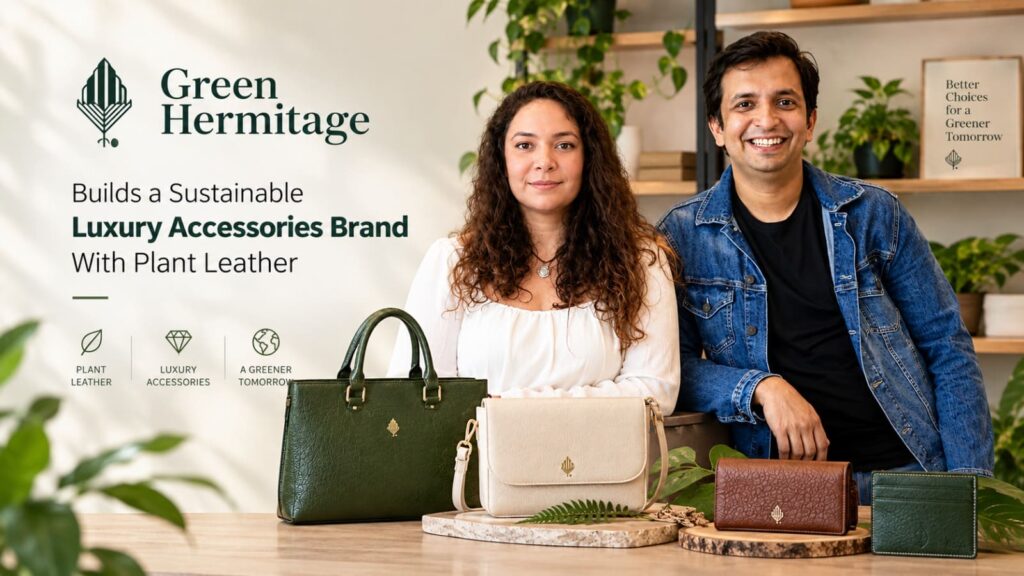
Green Hermitage Founders Build a Sustainable Luxury Accessories Brand With Plant Leather
- Blog Industry Startup Trending News
- Entrepreneurs Story News
- September 25, 2026
- 103
- 15 minutes read
Luxury accessories are undergoing a revolution as consumers seek alternatives to traditional materials. Leather production has serious environmental effects such as deforestation, high carbon emissions, and the use of chemicals in its production process. PU and PVC are synthetic leather alternatives, derived from fossil fuels, which are the source of the world’s microplastic pollution problem.
Visionary designers are creating next-gen materials in luxury fashion to bring together the two concepts of luxury fashion and sustainability. Among these designers, The Green Hermitage founders stand out as visionaries in eco-design with their performance-based plant-based leather goods. Luxury accessories without compromise on quality or elegance – combining the power of material science and traditional craftsmanship.
It can be very insightful to understand the process the founders of the Green Hermitage are going through to understand how principles of circular design could transform global retailing. The Green Hermitage sustainable luxury brand shows that sustainable luxury is no longer a fringe concept with the proper material choice, ethical local supply chains, and manufacturing.
Founders Gayatri Varun & Anubhav Pratap Rai Story
The Green Hermitage founders’ story began with an unexpected moment of frustration that sparked a sustainable revolution. In 2021, the founders were inspired to think about the durability, ethics, and sustainability of everyday office items when they saw a traditional leather bag tearing in a packed Delhi Metro train. Such an experience gave rise to a serious quest for eco-friendly materials to replace premium animal-skin products.
This is what gave birth to the vision that has led to the success of the Startup, and that was realized by the founders of Green Hermitage through their unique capabilities and backgrounds.
This is what gave birth to the visionThis is what gave birth to the vision that has led to the success of the startup, and that was realized by the founders of Green Hermitage through their unique capabilities and backgrounds; Gayatri Varun, a previous lawyer with an MSc in Climate Change from the esteemed University of Leeds (Education). The other founder of this venture is Anubhav Pratap Rai, who brings along with him significant engineering and financial knowledge.
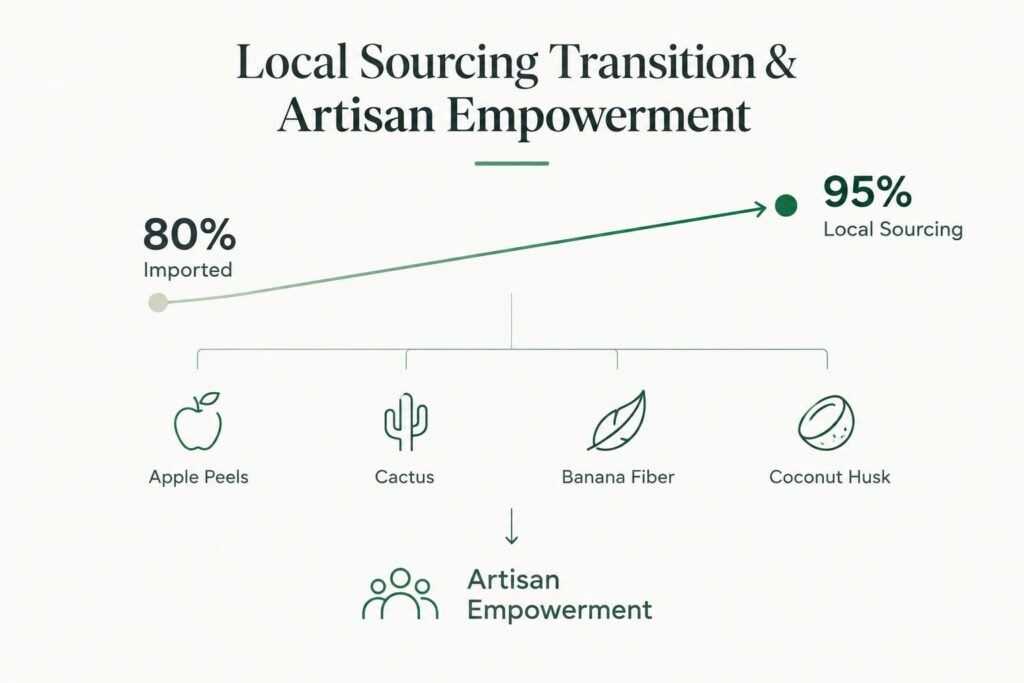
Local Sourcing Transition & Artisan Empowerment
Turning the concept into a commercial success was a hard journey for this firm. In the initial days, the firm had to import almost 80% of its bio-materials from foreign countries. However, after realizing the carbon footprint that long-distance transportation would create, the founders of Green Hermitage have been able to redesign the supply chain. As a result, more than 95% of their bio-materials are procured from local Indian sources, including agri-waste such as apple peels, cactus, banana fiber, and coconut husk.
Aside from innovations in materials, the brand is very socially responsible in empowering the artisans of India. Through the use of the latest bio-materials along with their handcrafted processes, the brand offers quality products through socially responsible manufacturing practices. This has been proven through each of the authentic Green Hermitage plant leather reviews of their products.
Industry & Cross-Sector Synergy: Scaling Next-Gen Materials
Creating a sustainable luxury brand requires deep integration across multiple modern industry sectors. Finance still sees early-stage Funding for next-gen material startups as critical to scaling specialized processing infrastructure. The Green Hermitage founders used targeted capital investments to grow their material research and to demonstrate the financial viability of circular fashion models to institutional investors.
The Manufacturing industry requires sophisticated technology to convert organic agricultural waste into durable textile material. While tanneries release toxic chemicals into the environment, plant processing is based on eco-friendly technologies that are based on mechanical and biological principles. The use of such eco-techniques guarantees that the Green Hermitage company is a model in terms of eco-friendly manufacturing compared to other startups.
Effective Marketing is the best way to communicate the value of Next-gen materials in luxury fashion. Consumers today want more transparency from brands, and the story needs to be authentic for it to catch on in the market. Green Hermitage strengthens its position as a transparent Green Hermitage sustainable luxury brand that leads with purpose by educating the public about bio-composition and circularity.
Full Material Comparison
To see why plant-based materials are the future of luxury, it’s useful to put them in direct comparison with traditional animal hides and petroleum-based synthetics
Comparison Criteria | Plant Leather (Green Hermitage) | Traditional Animal Leather | Synthetic PU/PVC Leather |
Carbon Footprint | Very Low (Sourced from agri-waste) | Very High (Methane, deforestation) | High (Petroleum extraction & refining) |
Durability & Feel | High (Engineered bio-polymers) | Very High (Natural fiber density) | Moderate (Peels over time)
|
Bio-Composition | Up to 95% Plant-Based/Organic | 100% Animal Origin | 100% Synthetic Petrochemicals
|
Ethical Impact | Cruelty-Free & Fair Artisan Labour | High Animal Cruelty & Hazardous Tanning | Non-Biodegradable Microplastic Waste |
Production Cost | Moderate to High (Scaling R&D) | High (Rawhide processing & tanning) | Low (Cheap mass manufacturing)
|
Tech Integration | Advanced Bio-Textile Technology | Traditional Chemical Tanning
| Standard Plastic Extrusion |
Future Perspectives & Circular Economies
The global fashion industry has quickly moved toward circular economy principles, where products are designed with the ability to be recycled or biodegraded. The fast-fashion trend is slowing down, as shoppers are turning to classic styles. The business model has matched well with this changing consumer behavior, pioneering products in the Green Hermitage sustainable luxury brand range.
As we look ahead to the future, the Green Hermitage founders’ story will continue to inspire entrepreneurs in India and across the globe. The founders of Green Hermitage have proven that luxury fashion can be sustainable as well, with continued research into bio-materials formulations and an expanding product line of work accessories. Any Green Hermitage plant leather review will tell you this.
Frequently Asked Questions (FAQ's)
1. What are the materials used by the founder of Green Hermitage for their accessories?
The founders of Green Hermitage use the highest quality plant leather made from agricultural waste such as apple, cactus, banana and coconut fibers.
2. How does the strength of plant leather compare to animal leather?
Yes, the plant leather used in luxury fashion has all the qualities of traditional leather, such as high water resistance, tensile strength and high daily durability.
3. How does the carbon footprint of plant leather compare to synthetic leather?
Because it is made from renewable resources and not petrochemicals derived from fossil fuels, plant leather has a much smaller carbon footprint.
4. Where can I read a review of Green Hermitage plant leather?
You can also read top sustainable fashion sites’ verified customer reviews and Green Hermitage plant leather review articles