


From Bengaluru Traffic to EVs: How Yulu Turned a City Problem Into a Business Opportunity
- Blog Industry Startup Trending News
- Entrepreneurs Story News
- October 6, 2026
- 24
- 15 minutes read
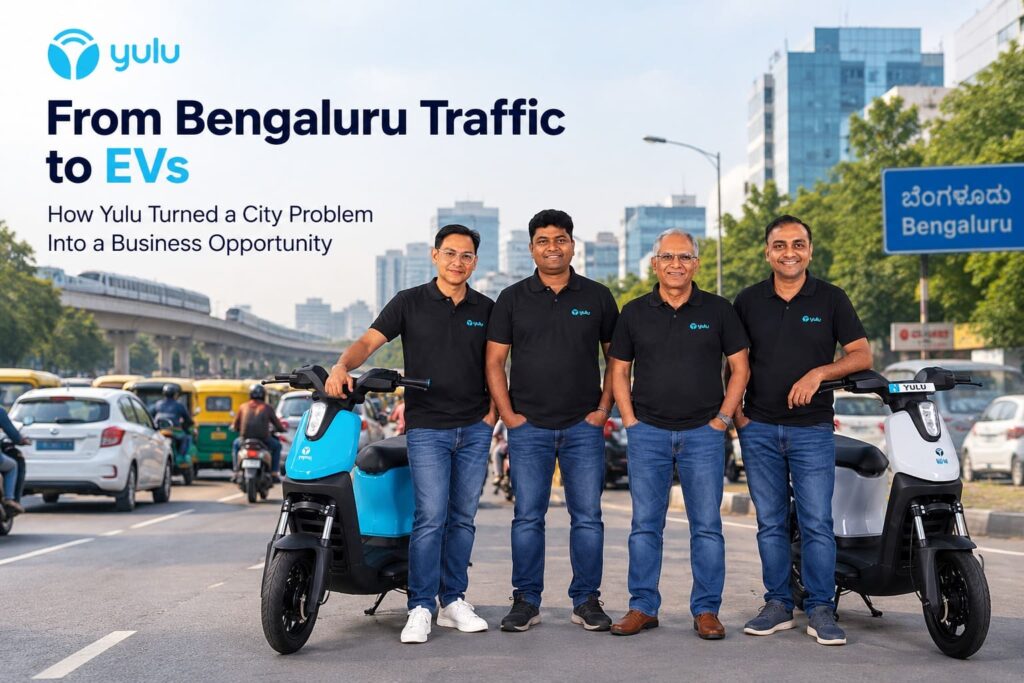
Urban traffic congestion has always been a challenge faced by workers in metropolitan cities of India. But for the founders of Yulu, it was not just an irritating problem. It was a big gap in the urban transport system that needed a realistic approach.
This business model took the concept of our traveling habits and turned them upside down to create a business out of the problem in the urban environment. Now, the company is revolutionizing the urban transport system.
Yulu: About the Company
Founded in 2017 in Bengaluru by Amit Gupta, RK Misra, Naveen Dachuri, and Hemant Gupta, Yulu is the first of its kind shared electric micro-mobility company. The company focuses on sustainable urban mobility, offering small electric two-wheelers for short-distance commuting and last-mile delivery.
It’s for everyday commuters and gig workers fighting urban traffic congestion and slashing carbon emissions, carving out a strong commercial footprint in India’s green mobility space.
Factor | Yulu | Conventional Two-Wheeler | Auto/Cab |
Vehicle type | Electric Micro-Mobility | Fuel-powered Motorcycle | Petrol/CNG Car or Auto |
Best suited for | Short-distance mobility | Long & short commutes | Point-to-point transit |
Electric mobility | 100% Electric | None | Mostly Fossil Fuels |
Last-mile use | High efficiency | Moderate | Low convenience for alleys |
Ownership requirement | Pay-per-use shared model | Complete personal purchase | On-demand hired service |
Company Profile
The venture was born in Bengaluru, the country’s leading technology and startup hub. The enterprise was born in 2017 from a shared wish to address urban chaos and air pollution.
The founding team had diverse professional backgrounds in engineering, operations & design, all united by a passion for urban transformation.
They saw that personal cars were not good for short trips and caused serious congestion. Bengaluru’s singular topography and tech-savvy population created an ideal testing ground for early operational strategies.
The company eventually shifted from general rentals to niche shared mobility solutions, carving out a distinct space in India’s broader electric-vehicle and micro-mobility market.
Founders vision and mission statement
The founders worried about the cost, inefficiencies, and environmental impact of commuting into the city. The vision was to provide all with smooth, affordable, and eco-friendly urban mobility. They believed in a creative way to cut down on the use of fuel-consuming vehicles for short journeys within city limits.
The key to the solution was electric mobility: clean energy with convenience. Their mission is linked to sustainable urban transportation, ensuring cities stay livable as populations grow. Bengaluru’s highly commercialized areas and consumers provided the perfect backdrop for the founders’ vision.
Bengaluru Traffic Can Earn Money
Traffic jams in Bengaluru were a great kick-start for the new business model. Daily commuters struggled during peak office hours. Commuting less than five kilometers was cumbersome, expensive, and environmentally unfriendly for normal cars and heavy motorcycles.
Yulu electric scooter Bengaluru traffic management policies caused Yulu electric scooters to naturally converge here. Electric scooters were a handy way to navigate long queues and tight corridors.
The company analyzed the transport needs of people and found out there was a great demand for efficient and affordable means of transport from consumers.
Yulu: EV & Micro-Mobility Model
The core of the service is built around light electric two-wheelers, made for easy use in the city. The cars operate under a shared mobility model, where users pick up and drop off in designated zones in their neighborhood.
This system is a huge boost to last-mile connectivity between metro stations and office parks. Bengaluru EV Micro-mobility Yulu deployments demonstrated how shared assets reduce the overall vehicle load on congested streets.
The sophisticated battery infrastructure ensures continuous use, meaning the vehicles are charged and ready to go each day.
Fleet monitoring is made seamless with technology at the heart of every vehicle operation. Therefore, these Yulu electric vehicles that Bengaluru users depend on seamlessly fit into the city’s larger green transit ecosystem.
Yulu’s Business Model
There is a need to balance asset utilization with low operational overheads to create sustainable revenue in shared transportation. The Yulu business model Bengaluru case study presents a dockless and docked hybrid sharing mechanism with affordability at its foundation.
The main users are daily office-goers, students, and gig workers. We leverage strategic alliances with metro authorities, municipal bodies, and real estate developers to secure prime parking zones across the city.
As the needs of the city changed, the business grew from general public rentals to meet the booming delivery sector. But the lifeblood of this model is operational efficiency, which drives maintenance schedules and asset placement.
Last Mile Delivery and the Gig Economy
The rapid growth of quick commerce and food delivery services created a whole new operational vertical. Delivery riders need affordable mobility for regular short urban trips during daytime. For gig workers who travel hundreds of miles a day, fuel is a major operational expense compared to the average commuter.
Yulu electric vehicles Bengaluru delivery fleets came up with a perfect solution to this pain point, with affordable rental options.
The enterprise built up a loyal commercial user base by customizing its fleet to meet these particular delivery needs. The adoption of micro-mobility solutions in India directly supports the thriving gig workforce, even as it lowers urban carbon emissions.
Technology and Operations
Running a huge number of two-wheelers as part of a sharing program requires modern technological capabilities. A customer is provided with immediate unlocking of a vehicle thanks to special mobile applications.
Real-time location tracking, as well as fleet management through the use of data, ensures that there is no theft or loss of a shared two-wheeler.
Battery-swap networks enable minimizing downtime during charging. Special algorithms analyze peak demand moments in order to relocate shared vehicles.
Growth of the Business and Market Effects
In addition to its current geographical reach, the brand went further ahead to expand into other key cities in the country. There are some important lessons for Indian entrepreneurs trying to grow a venture in an environment that is full of regulatory issues and infrastructural shortcomings.

In its efforts to solve some of the urban transportation problems, the brand made sure to bring electric motorcycles to life as a mode of transport. Growth through use-case expansion made the company relevant in the market.
Micro-Mobility for India
“Smaller electric cars might be the solution to tough urban transit puzzles throughout the country.” Penetration of micro-mobility solutions in India contributes to reducing acute traffic congestion in crowded metros.
These smaller solutions also tackle the persistent last-mile connectivity problem between mass transit stations and homes.
They are also a sustainable mode of transport to cover short distances and reduce a lot of vehicular emissions. The incorporation of these vehicles into the daily life of the city requires the active collaboration of civic authorities and private mobility providers.
Conclusion
The traffic jam of Bengaluru showed that everyday urban hassle could be converted into a business lesson.
The history of Yulu shows that it is possible to create a robust business by understanding the difficulties of locals and coming up with tech-based solutions.
By turning an urban problem into a micro-mobility solution, the company revolutionized short-distance travel in India.
Frequently Asked Questions (FAQ's)
1. When did Yulu begin?
Established in 2017.
2. What problem does Yulu solve?
Issues covered include urban traffic congestion, last-mile connectivity, and short-distance transit issues.
3. Yulu’s part in India’s electric micro-mobility?
It provides electric two-wheelers and battery swapping stations for daily commuters and delivery personnel.