


Aadit Palicha Success Story: From a College Dropout to Zepto’s Co-Founder
- Blog Industry Success stories Trending News
- Entrepreneurs Story News
- October 3, 2026
- 133
- 23 minutes read
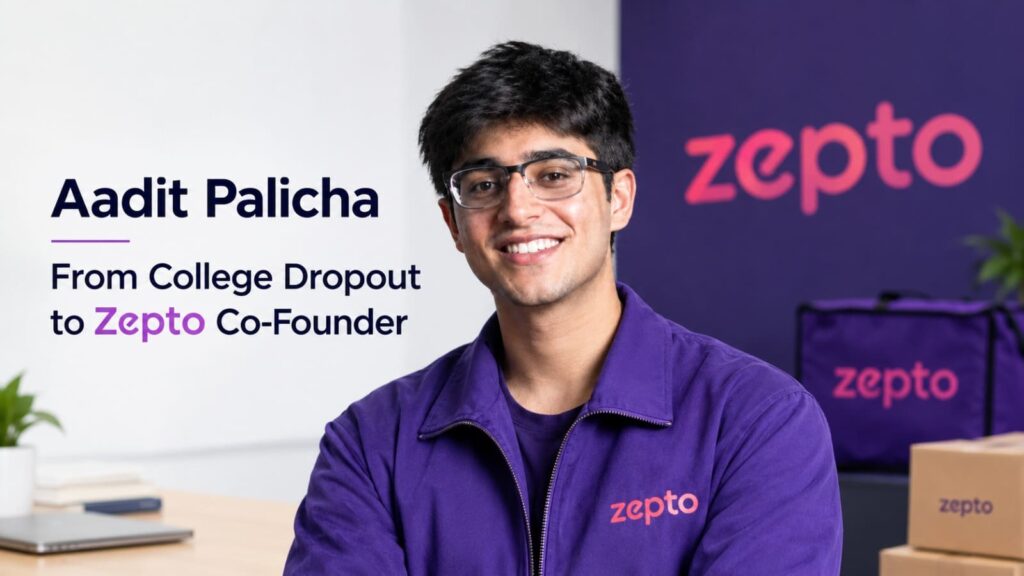
Online grocery shopping in India looks nothing like it did five years ago, and a large part of that shift traces back to one founder’s refusal to accept slow delivery as the norm. The Aadit Palicha success story is the story of how a 19-year-old college dropout helped rewire how urban India buys its daily essentials.
Palicha is co-founder and CEO of Zepto, the quick-commerce platform that made 10-minute grocery delivery a mainstream expectation rather than a gimmick. His path — from a teenage coder in Dubai to the head of a multi-billion-dollar company — says as much about timing and conviction as it does about technology.
Hometown and Childhood
Aadit Palicha was born in 2001 in Mumbai, Maharashtra, India. Much of his childhood, however, was spent in Dubai, where his family had relocated for business.
He showed an early interest in computers, and by his early teens he was already writing small programs and building simple games on his home PC the kind of hands-on tinkering that tends to show up later as an instinct for shipping products fast.
Family Background
Palicha grew up in a household that valued enterprise and independence. His father, Kavit Palicha, is an engineer who later became a stakeholder in Zepto, while his mother, Urvashi Palicha, runs Search Point, an executive recruitment firm.
Business conversations were apparently a normal part of dinner-table talk growing up, and that early exposure to risk-taking and operations is often cited as part of what shaped the extraordinary Zepto founder story that followed.
Study and Education
Palicha completed the International Baccalaureate (IB) diploma at GEMS Modern Academy in Dubai, where he was a strong all-round student.
His academic record was good enough to earn him a place in Stanford University’s computer science program, but Aadit Palicha’s education took an unplanned turn when the pandemic disrupted campus life, and he chose to step away from Stanford to pursue his startup full-time rather than finish the degree.
Early Life and Career Beginnings
Even before Zepto, Palicha had a habit of building things. While still in high school, he created GoPool, a carpooling app aimed at easing transportation gaps for students in Dubai an early, if modest, lesson in product thinking and market validation.
During the pandemic, he teamed up with his childhood friend Kaivalya Vohra to launch KiranaKart, a service that connected neighborhood grocery stores with online shoppers.
KiranaKart ran for roughly ten months before the founders concluded that partnering with existing kirana stores couldn’t deliver the speed or consistency they were after a hard but useful lesson that directly shaped the operational instincts behind what came next.
The Idea Behind Zepto
Zepto launched in 2021, built from the ground up around a single promise: grocery delivery in 10 minutes. Starting out of Mumbai, Palicha and Vohra abandoned the kirana-store partnership model entirely and instead built their own network of dark stores small, order-only warehouses stocked and positioned for speed rather than footfall.
The founders had spotted a real gap: consumers didn’t just want to order groceries online; they wanted them to show up almost instantly. Closing that gap meant rebuilding the supply chain from scratch, which became the backbone of the Zepto business model going forward.
Early Challenges and Difficulties
Running a rapid-delivery operation across India’s congested cities wasn’t easy. Micro-inventory management, hyper-local demand forecasting, and keeping delivery partners reliable were all live problems from day one.
Competition was fierce too, with well-funded incumbents and other quick-commerce entrants racing for the same customers.
Palicha’s team worked through it by refining delivery-route algorithms and tightening control over inventory wastage the kind of unglamorous, iterative fixes that quietly built a more resilient foundation for the company.
Turning Point: The Dark Store Strategy
The real inflection point came when Zepto fully committed to its Zepto dark store strategy, moving fulfillment away from retail-style outlets and into closed-door micro-warehouses run entirely on real-time demand data.
Order accuracy and delivery speed improved sharply, and that clarity of execution is what first caught the attention of major venture investors.
Business Growth and Expansion
Phase | Operational Focus | Key Metric / Milestone |
Launch Phase (2021) | Hyper-local pilot in Mumbai | Initial dark store network rollout |
Expansion Phase (2022–2023) | Scaling across top Indian metros | Unicorn status reached in August 2023 (~$1.4B valuation) |
Maturity Phase (2024–2026) | Deepening inventory, profitability, HQ moved to Bengaluru | Valuation crossed ~$7B by October 2025 |
As the table shows, Zepto moved from a single-city pilot to a nationwide operation in a few years.
The catalog grew well beyond basic groceries to include fresh produce, personal care, and household essentials, with the Zepto business model resting on tight unit economics, accurate demand forecasting, and a dark store network built for minutes, not hours.
Funding and Investors
Scaling a dark-store network at this pace required serious capital. Zepto has raised funding across multiple rounds from investors including Y Combinator, Nexus Venture Partners, Goodwater Capital, and Glade Brook Capital.
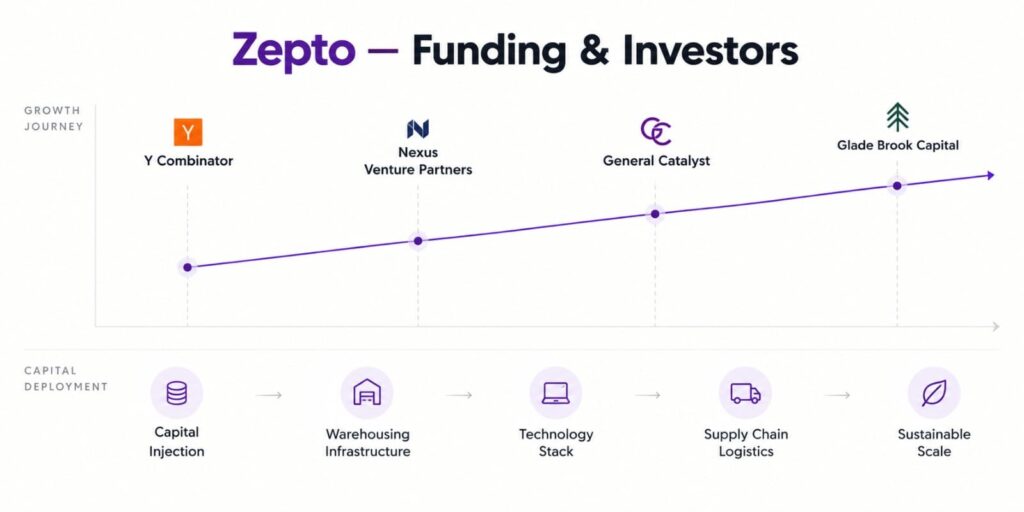
These rounds pushed Zepto’s valuation past the $7 billion mark by late 2025, with capital directed mainly at warehousing infrastructure, technology, and supply chain logistics all while keeping an eye on the path to profitability.
Technology and Operations
Modern quick commerce runs on more than fast bikes it runs on prediction. Palicha’s team leaned on machine learning early to forecast inventory needs, which helped cut stockouts on perishables without bloating warehouse costs.
That predictive layer remains central to the Zepto business model, enabling precise, hyper-local stocking that tracks real consumer demand rather than guesswork.
The company continues to experiment with automated sorting and AI-driven dispatch, incremental engineering gains that keep pushing delivery efficiency further.
This steady technology investment is as much a part of the Aadit Palicha success story as the dark stores themselves, proof that software, not just logistics, is what holds the model together at scale.
Workplace Culture and Team Empowerment
Building a company at this speed takes more than capital and code; it takes people willing to own hard problems early in their careers.
Under Palicha, Zepto has leaned toward a flat structure where young employees are given real ownership of logistical challenges, an approach credited with keeping the team motivated through rapid scaling.
Select Accomplishments
Palicha’s work has drawn recognition both in India and internationally. He has appeared on the Forbes India 30 Under 30 list and the Economic Times 40 Under Forty list, and he has featured among the youngest entrepreneurs on the Hurun India Rich List. These milestones have cemented his standing as one of the sharper young voices in Indian retail technology.

Leadership and Business Strategy
As a young CEO, Palicha’s style leans heavily on data and direct involvement; he’s known for spending time with warehouse staff and delivery teams to understand bottlenecks firsthand rather than relying only on dashboards.
His stated philosophy favors speed of execution and adaptability over rigid long-term planning, which tracks with how fast the quick-commerce market itself keeps shifting.
Personal Life
Palicha splits his time between Mumbai and Bengaluru and keeps a fairly low public profile outside of work. By most accounts, he remains genuinely interested in software engineering and emerging technology, and he credits his close family circle with keeping him grounded through the pressures of running a high-growth company at a young age.
Net Worth and Earnings
Wealth trackers estimate Aadit Palicha’s net worth at roughly ₹3,500–5,380 crore (around $420–650 million) as of 2026, making him one of India’s youngest self-made entrepreneurs in this bracket.
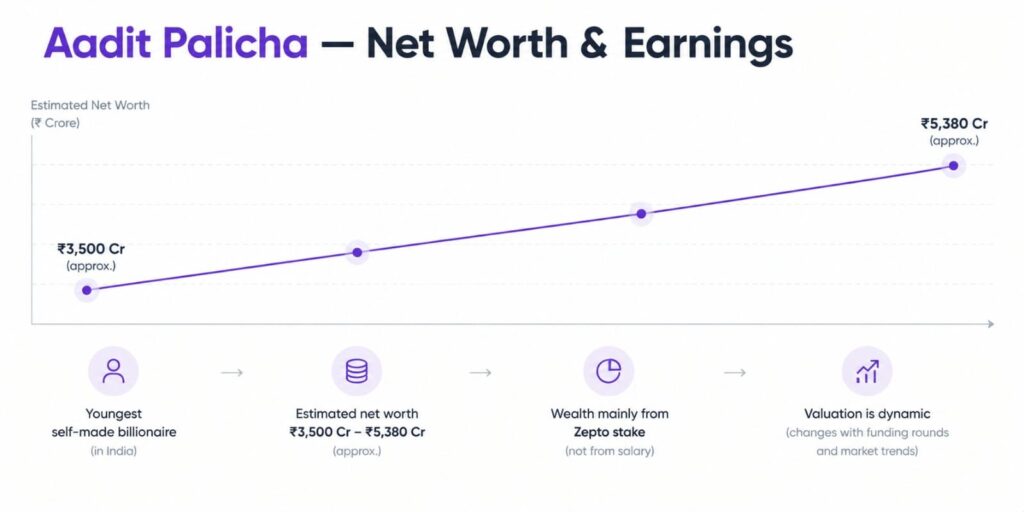
Almost all of that value is tied to his equity stake in Zepto rather than salary, which means the figure moves with the company’s private funding valuation and isn’t a fixed, audited number.
Career and Recent Developments
Palicha remains CEO of Zepto today, steering the company through a phase focused on cost discipline and preparations tied to potential public-market milestones.
Even as competition in quick commerce intensifies, he has stayed focused on building sustainable retail infrastructure across urban India, the next chapter in an already eventful Zepto founder story.
Lessons from the Journey
A few things stand out from this story for anyone building something new. First, consumer pain points that feel like minor friction in daily life can hide genuinely large opportunities.
Second, a narrow, well-executed operational playbook in this case, the Zepto dark store strategy can outcompete more established, broader rivals.
And finally, calculated risk-taking matters: the Aadit Palicha dropout decision walking away from a Stanford computer science degree to bet on an unproven idea is a reminder that full commitment, at the right moment, can pay off disproportionately.
Quick Facts: Aadit Palicha and Zepto
Category | Detail |
Full name | Aadit Palicha |
Born | 2001, Mumbai, Maharashtra, India |
Raised in | Dubai, UAE (family relocated for business) |
Education | IB Diploma, GEMS Modern Academy, Dubai; Computer Science, Stanford University (left before completing the degree) |
First venture | GoPool — a student carpooling app built in Dubai, around age 17 |
Co-founder | Kaivalya Vohra |
First startup with Vohra | KiranaKart (2020) — a grocery-delivery pilot that ran for about 10 months before being rebuilt as Zepto |
Company founded | Zepto, 2021, Mumbai (HQ later moved to Bengaluru in 2024) |
Core promise | 10-minute grocery delivery via dark stores |
Key investors | Y Combinator, Nexus Venture Partners, Goodwater Capital, Glade Brook Capital |
Valuation (as of late 2025) | ~$7 billion |
Estimated net worth (2026) | ~₹3,500–5,380 crore (~$420M–$650M) |
Recognition | Forbes India 30 Under 30; Economic Times 40 Under Forty; Hurun India Rich List |
Summary
The Aadit Palicha success story is ultimately about disciplined execution meeting real timing: a founder who spotted a narrow but deep problem, committed fully to solving it, and built the operational backbone the dark stores, the forecasting, the team culture to make a 10-minute promise actually work at scale.
As quick commerce keeps reshaping how urban India shops, his journey from teenage coder to Zepto CEO is likely to stay a reference point for founders chasing speed as a genuine competitive edge.
Frequently Asked Questions (FAQ's)
1. Who is Aadit Palicha?
Aadit Palicha is an entrepreneur and the co-founder and CEO of Zepto, one of India’s largest quick-commerce platforms for grocery delivery.
2. What is Aadit Palicha famous for?
He is best known for co-founding Zepto and building its signature 10-minute grocery delivery model, a central chapter in the Aadit Palicha success story.
3. What is Aadit Palicha's educational background?
Aadit Palicha’s education includes an IB diploma from GEMS Modern Academy in Dubai and a computer science program at Stanford University, which he left before graduating — the Aadit Palicha dropout decision that preceded Zepto’s founding.
4. What is Aadit Palicha's current role?
He currently serves as the co-founder and Chief Executive Officer of Zepto.