


Urban Company Plans ₹2,500 Crore QIP Amid Rising Competition in the Home Services Market
- Blog Funding Industry Trending News
- Entrepreneurs Story News
- October 15, 2026
- 11
- 20 minutes read

India’s home services market has a new battleground, and it’s not the business that made Urban Company famous. The company’s board will meet on 16 October 2026 to consider raising fresh money. According to an Economic Times report, the plan is to raise ₹2,000–2,500 crore, mainly through a Qualified Institutional Placement (QIP). The company itself hasn’t announced the amount yet.
The reason is simple. Its old business of scheduled, book-in-advance services is doing well. But a new category of 10–15 minute, on-demand house help has opened up, and well-funded rivals like Snabbit and Pronto are moving fast. Standing still is not really an option.
What Is a QIP, and Why Now?
A QIP is a quick way for a listed company to raise money by selling shares to big institutional investors like mutual funds and insurance companies.
The board will also look at other routes, such as a preferential allotment or private placement, or a mix of these. The same meeting will review the company’s Q2 FY27 results.
Where Will the Money Go?
Media reports say about 40% of the money is likely to go to InstaHelp, the company’s quick cleaning and dishwashing service. The rest could be used for acquisitions, growing the core home services business and its Native brand of water purifiers and smart locks.
The main business is profitable on its own, but heavy discounts in the quick-service segment are eating cash. Fresh money lets the company keep fighting there without hurting the profitable core.
It already had ₹2,019 crore in cash and treasury investments as of 30 June 2026, so this raise is about building a bigger war chest, not survival.
A Quick Look at the Company
The company was founded in November 2014 in Gurugram by Abhiraj Singh Bhal, Varun Khaitan and Raghav Chandra. It started as UrbanClap and was renamed in January 2020. It uses technology to connect customers with trained professionals for salon services, cleaning, repairs, plumbing and more.
Today it also operates in the UAE and Singapore, and in Saudi Arabia through a joint venture. Its newer bets are InstaHelp and Native, its own range of home products.
Urban Company Funding and Investors
Before going public, Urban Company funding came from some big names in global venture capital. Key Urban Company investors over the years include Accel, Elevation Capital (formerly SAIF Partners), Bessemer Venture Partners, Steadview, Vy Capital, Tiger Global and Prosus.
The company became a unicorn in June 2021 after a $255 million Series F round led by Prosus Ventures, Dragoneer and Wellington Management, which valued it at $2.1 billion. In total, it raised over $400 million from private investors before listing.
Its IPO, worth about ₹1,900 crore (₹472 crore of new shares plus ₹1,428 crore sold by existing investors), was subscribed nearly 104 times.
Urban Company Valuation and Share Price
The Urban Company shares listed on 17 September 2025 at ₹162.25 on the NSE, about 57.5% above the IPO price of ₹103. Since then, the stock has moved between roughly ₹101 and ₹184.
On 14 October 2026, the Urban Company share price closed at ₹161.79, giving a market value of about ₹25,173 crore.
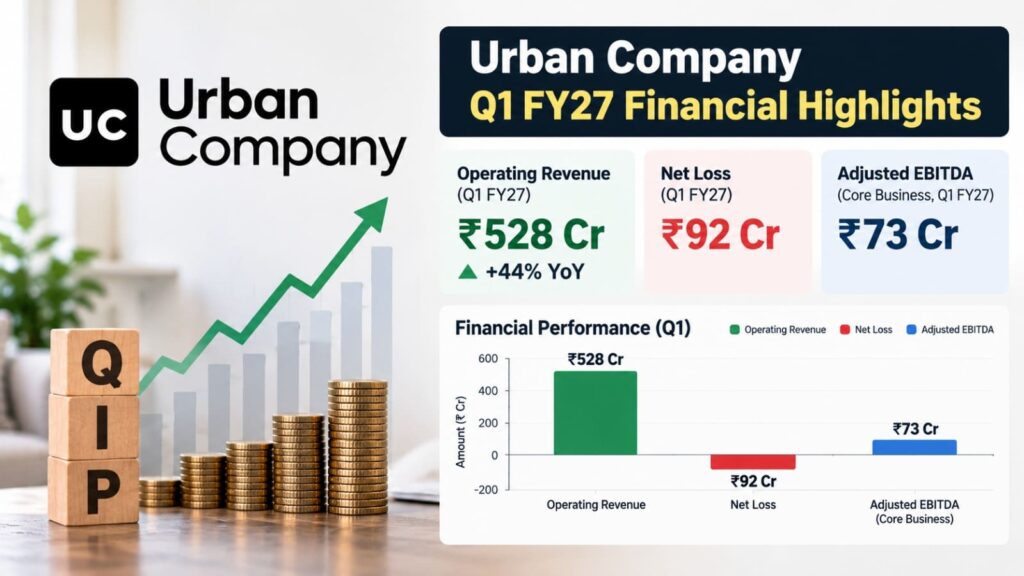
However, the heavy spending on promotions in the instant-help vertical for the quarter resulted in an overall net loss of Rs 92 crore. Our core business continues to generate consistent operating profits with adjusted EBITDA of Rs. 73 million for the same period.
Since the stock trades every day, the Urban Company valuation keeps changing with the market. After the Q1 results on 3 August 2026, the shares jumped about 13.6% in a single day.
Q1 FY27 Results: Strong Growth, but InstaHelp Is Costly
For the April–June 2026 quarter, revenue from operations rose 44% year-on-year to ₹528 crore. But there’s another side to it.
- Net loss: ₹92 crore, against a small profit of ₹6.9 crore a year earlier. It was, however, lower than the ₹161 crore loss in the previous quarter.
- Core business (excluding InstaHelp): Adjusted EBITDA profit of ₹67 crore.
- InstaHelp: Adjusted EBITDA loss of ₹132 crore. The good news is that the loss per order fell from ₹447 to ₹346, and orders grew 43% in the quarter to 3.82 million.
- Native: Revenue up 60% year-on-year to ₹95 crore.
Urban Company Competitors in Quick Home Services
The company still leads in scheduled home services. But in the under-15-minute segment, the two main Urban Company competitors are Snabbit and Pronto. Both are focused only on quick, on-demand cleaning and household help.
- Snabbit: Founded in 2024 by Aayush Agarwal, a former Zepto executive. It raised $56 million in a Series D round in April 2026, taking its total funding to $112 million.
- Pronto: Raised $20 million in a Series B round in May 2026, led by Lachy Groom, at a valuation of about $200 million.
Urban Company vs Snabbit
The Urban Company vs. Snabbit fight is really a full-service, listed company against a fast, focused startup. Snabbit’s valuation roughly doubled in about six months, from nearly $180 million in October 2025 to a reported $350–360 million after its latest round. It grew from about 400 jobs a day to around 40,000 daily jobs during FY26.
Factor | Urban Company | Snabbit | Pronto |
Founded | 2014 | 2024 | — |
Model | Scheduled services + InstaHelp + Native products | Only quick, on-demand chores | Only quick, on-demand chores |
Status | Listed on NSE and BSE | Private | Private |
Value | ~₹25,173 crore market cap (14 Oct 2026) | ~$350–360 million (reported, April 2026) | ~$200 million (May 2026) |
Latest raise | QIP of ₹2,000–2,500 crore under consideration (reported) | $56 million Series D (April 2026) | $20 million Series B (May 2026) |
Key Facts at a Glance
Category | Details |
Founded | November 2014, Gurugram (as UrbanClap; renamed in January 2020) |
Founders | Abhiraj Singh Bhal, Varun Khaitan, Raghav Chandra |
IPO | ₹103 issue price; listed 17 Sept 2025 at ₹162.25 (NSE); subscribed ~104 times |
Share price and market cap | ₹161.79; ~₹25,173 crore (14 Oct 2026) |
Proposed fundraise | ₹2,000–2,500 crore (as reported), board meeting 16 Oct 2026 |
Q1 FY27 revenue | ₹528 crore (+44% YoY) |
Q1 FY27 net loss | ₹92 crore (vs ₹6.9 crore profit in Q1 FY26) |
Adjusted EBITDA excl. InstaHelp | ₹67 crore profit |
InstaHelp adjusted EBITDA | ₹132 crore loss |
Cash and treasury investments | ₹2,019 crore (30 June 2026) |
Key investors | Accel, Elevation Capital, Bessemer, Steadview, Vy Capital, Tiger Global, Prosus |
Main quick-service rivals | Snabbit, Pronto |
What to Watch Next
First, the board’s final decision on 16 October, including the size and route of the raise. Second, whether InstaHelp’s loss per order keeps falling.
Third, how hard Snabbit and Pronto push with their fresh funding. Investors can track official updates on the company’s investor relations website.
Conclusion
This fundraise is a big moment for Urban Company. Not because the core business needs saving, but because quick home help has become a real fight for market share.
Used well, the money can help InstaHelp grow without hurting the profitable business that got the company here. For anyone following Indian startups and finance, this is one of the most interesting contests to watch.
Frequently Asked Questions (FAQ's)
1. How much is the company planning to raise?
About ₹2,000–2,500 crore, as reported by the Economic Times. The board meets on 16 October 2026 to decide.
2. What is the latest Urban Company valuation?
About ₹25,173 crore in market value, based on the 14 October 2026 closing price. It changes daily with the stock price.
3. What is the Urban Company share price?
It closed at ₹161.79 on 14 October 2026, against an IPO price of ₹103.
4. Who are the main Urban Company investors?
Accel, Elevation Capital, Bessemer, Vy Capital, Tiger Global and Prosus, among others.
5. How much Urban Company funding was raised before the IPO?
Over $400 million from private investors, including a $255 million Series F in 2021.