

Zetwerk: How Four Entrepreneurs Built a Manufacturing Network Without Owning Factories
- Blog Industry Startup Trending News
- Entrepreneurs Story News
- October 13, 2026
- 12
- 15 minutes read
Industrial supply chains have always been plagued by high costs, fragmented suppliers, and unmanageable production schedules.
By digitizing custom manufacturing and component procurement, tech startups are revolutionizing manufacturing at scale around the world.
Zetwerk has upended this space by showing that a company can deliver manufacturing capacity of unprecedented size with minimal to no asset management.
Zetwerk is a managed B2B marketplace for custom manufacturing services, founded in 2018. It brings together global companies and small and medium enterprise (SME) manufacturers from different sectors. Zetwerk also has proprietary software to manage production, quality control, and logistics from start to finish.
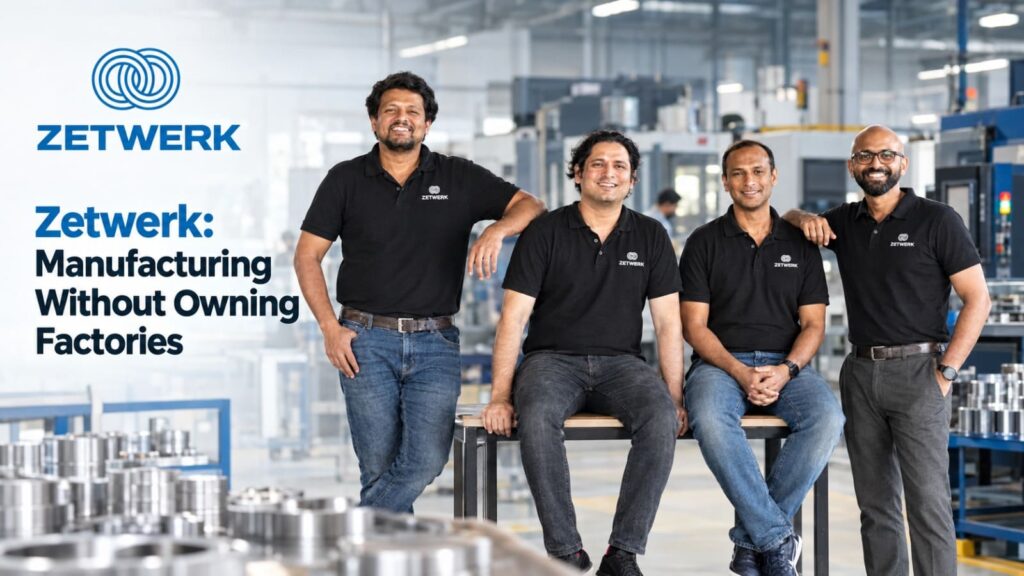
The four co-founders- Amrit Acharya, Rahul Sharma, Vishal Chaudhary, and Srinath Ramakrishna- soon found that small manufacturing facilities had spare capacity. Zetwerk is building a technology-led ecosystem to help factories run efficiently on specific engineering orders. It’s this model that transforms scattered local workshops into a single global manufacturing ecosystem.
Introduction to the Founders
Founded by 4 IIT graduates with deep competence in operations, technology & strategy, Zetwerk.
Amrit Acharya (Co-Founder & CEO): Amrit has a lot of industry experience, having worked with ITC and McKinsey & Co. He is an alumnus of IIT Madras and the University of California, Berkeley. He heads up the growth strategy and the corporate vision.
Srinath Ramakkrushnan (Co-Founder): An IIT Madras alumnus, Srinath had earlier worked with Amrit at ITC and brought a powerful set of supply chain execution and operations skills to the founding team.
Vishal Chaudhary (Co-Founder): An IIT Kharagpur alumnus, Vishal has experience in a varied set of corporate category operations in the industrial supply space.
Rahul Sharma (Co-Founder): An IIT Roorkee alumnus, Rahul built the technical backbone for Zetwerk and developed the software for real-time tracking of suppliers.
The Early Years of Zetwerk
For the first time in Zetwerk’s history, the company was seen as a software-as-a-service platform for procurement teams. The co-founders built software to manage suppliers for industrial buyers and keep track of project timelines.
But feedback from its first commercial customers revealed a more fundamental systems problem: the program couldn’t compensate for physical delivery lags or variable product quality.
With this insight, the team shifted to a fully regulated marketplace strategy. The corporation took ownership of order fulfillment, quality control, and on-time delivery, not just making the software work together.
The venture investors were early supporters, and the entrepreneurs quickly built up their network of suppliers. This change kicked off the bigger Zetwerk Success Story across the global industrial sectors.
Understanding the Business Model
Zetwerk case study is a good example of a business model based on managed orchestration vs. asset acquisition. The classic Zetwerk Business Model sits right in the middle of enterprise clients who require custom-engineered components and small-scale manufacturing partners.
The software handles the entire process from translating the digital design to sourcing the raw materials and shipping the finished product. Revenues are earned from margins on project execution and value-added supply chain management services.
Enterprise customers are guaranteed quality standards, on-time delivery, and single-point responsibility. And manufacturing partners benefit from sustained demand, higher utilization of their plants, and raw material purchase programs. This symbiotic architecture guaranties high capital efficiency throughout the network.
Traditional Manufacturing vs Zetwerk Understanding
Understanding how network-driven production contrasts with legacy asset-heavy operations highlights the key innovations within zetwerk company details.
Category | Traditional Manufacturing | Zetwerk Model |
Factory Ownership | Owns physical plants, machinery, and real estate. | Network-based model utilizing third-party manufacturing facilities. |
Capital Investment | Requires heavy upfront capital expenditure for capacity. | Asset-light framework requiring lower initial capital expenditure. |
Production Scale | Restricted by physical plant capacity and fixed tooling. | Dynamic scaling across thousands of manufacturing suppliers. |
Flexibility | Rigid production lines tailored to specific product categories. | High multi-sector adaptability across energy, electronics, and aerospace. |
Operational Scope | Manages direct in-house factory floor labor and equipment. | Oversees supplier coordination, quality control, and end-to-end logistics. |
Growth & Key Milestones
Zetwerk’s scaling up of operations and cash allocation are a sign of its rapid rise. Launched 8 years ago, the platform achieved unicorn status, attracting investment from top venture capital firms like Peak XV Partners, Lightspeed, Accel, and Greenoaks.
Over the years, the company expanded from structural steel fabrication to include precision electronics, consumer products, and renewable energy components. The company’s momentum was helped by international expansion.
The company created a strong network of supply chain nodes in North America, Southeast Asia and the Middle East, linking global buyers with manufacturing capacity in the region.
Key institutional customer contracts, including major infrastructure and energy projects, further evidenced the platform’s ability to consistently deliver large engineering requirements.
Business Challenges and Lessons
A network-based manufacturing business faced many operational challenges. Initially, the issue of maintaining similar production quality across different workshops independently was a challenge.
This challenge was tackled by incorporating stringent quality control measures and sending field engineers to the partnering workshops to check the production output.
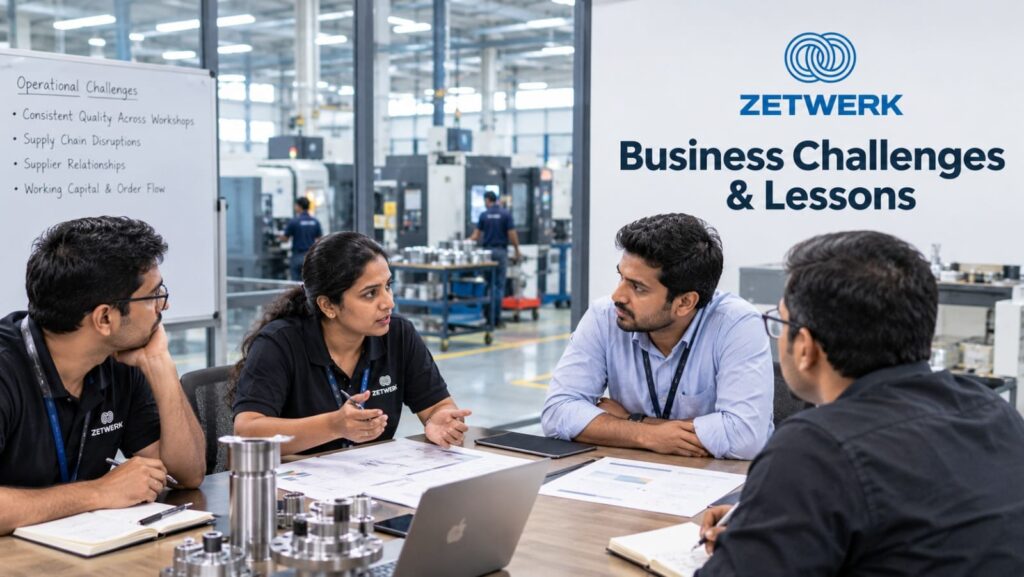
Tracking global supply chain disruptions in the event of macroeconomic challenges was one challenge that needed to be solved.
The other important business lesson learned was the need to have good relationships with smaller supplier companies. This was accomplished through the provision of working capital and consistent order flows to make them loyal.
Current Business and Future Plans
Today, Zetwerk is one of the world’s largest managed contract manufacturing networks. The corporation is involved in several fast-growing areas such as solar energy components, aircraft parts, automobile infrastructure, and consumer electronics.
The company is still growing its market footprint with thousands of active manufacturing partners and enterprise buyers across the globe. The platform plans to spend extensively in artificial intelligence for production scheduling, cost prediction, and supply chain tracking.
The management team is focused on growing its overseas production hubs and reinforcing its home capabilities. The next step in the progression of zetwerk history is getting ready for an initial public offering.
Conclusion
This Zetwerk Success Story is a great journey of digital transformation of traditional B2B manufacturing. The four founders built a managed network that leveraged latent factory capacity to deliver enterprise buyers speed, transparency, and reliability.
Their asset-light model is a textbook example of modern supply chain management. As the world rushes to build durable and diversified supply chains, Zetwerk is perfectly positioned to fuel future industrial output.
The founders showed that you don’t need to own a single factory floor to develop a global manufacturing behemoth, marrying strong technical skills with the latest digital technologies. The company continues to shape the future of contract manufacturing around the world.
Frequently Asked Questions (FAQ's)
1. What year was Zetwerk founded?
Zetwerk was founded in 2017 & officially commenced its operations in May 2018.
2. Who are the founders of Zetwerk?
The founders of Zetwerk are Amrit Acharya, Rahul Sharma, Vishal Chaudhary, and Srinath Ramakrishna.
3. What is the Zetwerk Business Model?
The Zetwerk Business Model is a managed B2B marketplace to facilitate collaboration between enterprise buyers and third-party manufacturing partners for customized production.